Winternachten Saturday night

20080207102859

‘There is no hope which isn't mixed with fear, and there is no fear which isn't mixed with hope’, said Spinoza. Friday fear arose in various shapes at Winternachten, tonight the perspective shifts: how to get ‘Ghost Ship the World’ on course again? On five stages you can listen to, watch and get carried away by the question of how we relate our faith in the future. Will we manage without illusions? Make your journey from fear to hope, and plan your route in the programme, which takes places on the five stages. The programme is partly in English and partly in Dutch.

Programme schedule available for download now
The programme schedule of Winternachten Saturday Night is now available to download here as a PDF (Acrobat Reader)-file.

Information

Date and time Saturday 19 January 2008 from 20:00 to 01:30 hrs
Location Theater aan het Spui & Filmhuis Den Haag

Tijdschema 19 January

Filter by location:
Filter by spoken language:
Time Location
20:00 - 21:00 Theater aan het Spui - grote zaal Between fear and hope. Part 1: science
20:00 - 21:00 Theater aan het Spui - kleine zaal Forbidden words
20:00 - 21:00 Filmhuis - zaal 7 Berber poetry and prose: In stone I'll write
20:00 - 21:20 Filmhuis - zaal 6 Great Dicatation in Papiamento/u of the Kingdom of the Netherlands
20:00 - 23:55 Theater aan het Spui - foyer Foyer programme
21:10 - 21:30 Theater aan het Spui - kleine zaal Music: Salimata Diabaté
21:10 - 21:30 Theater aan het Spui - grote zaal Music: Haytham Safia Qu4rtet
21:10 - 22:01 Filmhuis - zaal 7 Who's Afraid of Youth? Pupils have the floor
21:30 - 22:30 Filmhuis - zaal 6 Film: Trefossa. World premiere
21:40 - 22:01 Theater aan het Spui - grote zaal Between Fear and Hope Part 2: literature & architecture
21:40 - 22:01 Theater aan het Spui - kleine zaal Young + Urban + Writer
22:35 - 23:00 Theater aan het Spui - kleine zaal Music: Salimata Diabaté
22:35 - 23:00 Theater aan het Spui - grote zaal Music: Haytham Safia Qu4rtet
22:35 - 23:55 Filmhuis - zaal 7 Prophesies of the new generation of poets
23:05 - 23:55 Theater aan het Spui - grote zaal Between Fear and Hope Part 3: art and religion
23:05 - 23:55 Theater aan het Spui - kleine zaal Traditions, taboos, belief and superstition. Writers from the Antilles and Surinam
23:05 - 23:55 Filmhuis - zaal 6 The film choice of A.F.Th. van der Heijden
23:55 - 01:30 Theater aan het Spui - foyer Music: Rabasa

Tan Lioe Ie

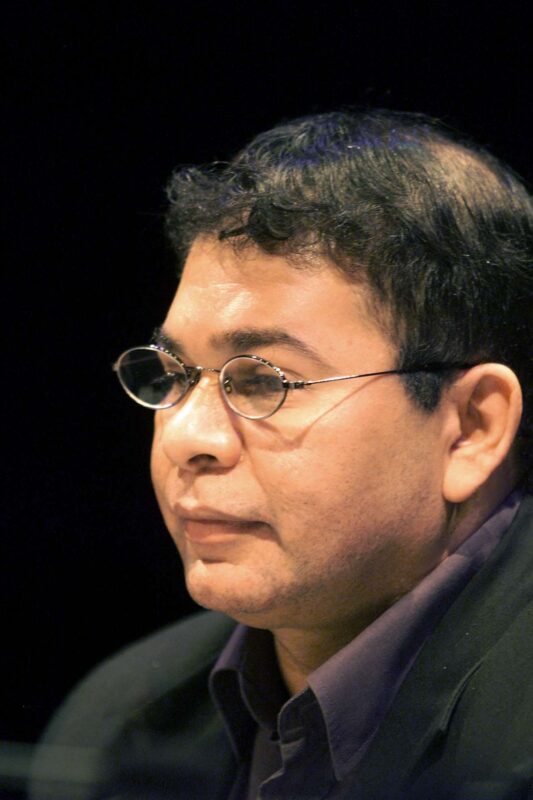
was born in 1958 in Denpasar (Bali, Indonesia). He studied architecture at Jakarta university before completing his undergraduate in economics at Udayana University. His poetry anthology Kita Bersaudara has been translated and published under the title We Are All One. His latest poetry book is Malam Cahaya Lampion. He was invited to the Tasmanian Readers' and Writers' Festival and the Literary Festival Winternachten Overseas in Surinam (2006). He was Writer in Residence in Hobart, Tasmania. He enjoyed to create music of poetry. He is active with the Sanggar Mimum Kopi (SMK) community, Bali, and the guest editor of Coast Lines magazines and editor of CAK and Paradox.
20080206093553

Louise O. Fresco

(Meppel, NL, 1952) is a writer, agricultural scientist and columnist. In her novels De Kosmopolieten (The Cosmopolitans, 2003), De Tuin van de Sultan van Rome (The Roman Sultan's Garden, 2005) and De Utopisten (The Utopians, 2007) idealism, power, and friendship play important roles. Subsequently, she published Nieuwe Spijswetten (New Laws for Food, 2006), Hamburgers in het paradijs. Voedsel in tijden van schaarste en overvloed (Hamburgers in paradise. Food in times of shortage and abundance, 2012), Kruisbestuiving. Over kennis, kunst en het leven (Pollination. About knowledge, art and life, 2014) and various others works among which Verraad, Verleiding en Verzoening (Treason, Temptation and Reconciliation, 2010, with Helen Westerik). Fresco's Paradijs (Fresco's Paradise, 2013) is a six-part documentary TV-series broadcast by Human, published with an accompanying text. In 2014 she was appointed chair of the executive board at Wageningen University and Research. Her latest novel De Idealisten (The Idealists) will be published late January 2018.
20140910175118 1

Joris Luyendijk

(Amsterdam, 1971) travelled to Egypt at age 24 to do research among Egyptian contemporaries. That not only earned him a degree in religious anthropology, but also his debut, Een goede man slaat soms zijn vrouw (A Good Man Sometimes Hits his Wife). It was an instant success and Volkskrant and Radio 1 Journaal asked him to become a correspondent in the Arab World. Later he also worked for NRC Handelsblad and NOS. During his stay he wrote Een tipje van de sluier (A Corner of the Veil) and after his return to the Netherlands in 2003 Het zijn net mensen (People Like Us), on his experiences as a correspondent. Meanwhile Luyendijk has shifted his attention elsewhere: Dutch politics and sustainability. His latest book, Je hebt het niet van mij, maar…Een maand aan het Binnenhof (Don’t mention my name, but… A Month in Parliament), caused a great deal of controversy in Dutch journalist circles. Joris Luyendijk took a closer look at the bell-jar world of Dutch politics. With some amazement he describes how close the link between journalists, lobbyists, public relations officials and politicians is. In 2006 and 2007 Luyendijk hosted the tv interview programme Zomergasten (Summer Guests) and in 2007-2008 and 2008-2009 Wintergasten (Winter Guests). Since March 2010 he is one of the regular hosts of the late night radio current affairs programme Met het oog op morgen (With a View to Tomorrow).
20080206105246

Alfred Schaffer

(Leidschendam, 1973) is a poet, translator and lecturer at the University of Stellenbosch, South Africa. He made his debut in 2000 with the poetry collection Zijn opkomst in de voorstad (His Rise in the Suburb). Over the years, his poetry collections were often awarded or nominated for several important prizes, and translations appeared in English, Afrikaans, French, Chinese, Indonesian, Swedish and other languages. For the collection Kooi he received the Jan Campert Prize and the Ida Gerhardt Poetry Prize in 2008. His work is sometimes humorous, sometimes matter-of-fact and at the same time full of absurd inventions. In 2014, he published his, again critically acclaimed collection Mens Dier Ding. In 2021, he published the personal collection Wie was ik?, for which he received the Herman De Coninck Prize. That same year, Alfred Schaffer was awarded the P.C. Hooft Prize, the largest annual oeuvre prize in Dutch literature.
20250116131023 1

Ronald Plasterk

(1957, The Hague) was appointed Minister of Education, Culture and Science in February 2007 for the Dutch Labour Party in the Cabinet of prime minister Balkenende. Plasterk is a biologist, specialised in molecular genetics and has won various prizes in biology, including the EMBO-award for Communication in the Life Sciences in 2002 and the Prix Louis D of the Institut de France in 2005. Between 1993 and 2003 he was among other things professor at the Vrije Universiteit in Amsterdam, the Universiteit van Amsterdam and the Universiteit Utrecht. Before his appointment as minister Plasterk was director of the Hubrecht Laboratorium, Nederlands Instituut voor Ontwikkelingsbiologie (KNAW) in Utrecht. As a columnist for tv, de Volkskrant and Intermediair Plasterk was noted for his outspokenness. A number of his columns were published in Leven uit het Lab (Living from the Lab) (2000)
20071128115139

Michaël Zeeman

(Marken, 1958-2009) was a poet, a writer and a commentator, with a regular column on the Forum page and the book pages of the Volkskrant. Zeeman was the editor of the arts section of the Volkskrant and from 2006-2007 its Rome correspondent. In 2006 he and the writer Abdelkader Benali published an exchange of letters, exchanging ideas on politics, life, love and literature. In 2002 Zeeman received the Gouden Ganzenveer (Golden Goose Quill) for his merits for Dutch literature. Zeeman became well-known in the 1990s as the host of his monthly book programme 'Late at night after a short walk', later to be renamed 'Zeeman with books'. In 1991 he published his first volume of poetry, Beeldenstorm (Iconoclasm), winning him the C. Buddingh Prize. His second volume Verhoudingen (Relationships) appeared in 1995. In the same year he published short stories entitled De Verduistering (The Darkening). He died in 2009.
20080206143715

A.F.Th. van der Heijden

(1951, Geldrop) is regarded as one of the greatest postwar Dutch writers. He wrote two cycles of novels. In his second cycle Homo Duplex the novels Movo Tapes (2003), Drijfzand Koloniseren (2006) and Het Schervengericht (2007) appeared. In the last book A.F.Th. tells about the great director Roman Polanski, who ends up in a Californian prison, in the same unit as the murderer of his wife and unborn child. For the cycle he abridged his name to A.F.Th. In 2007 appeared Mim, a novella on the occasion of the 80th birthday of Harry Mulisch. Between 1983 and 1996 he published The Toothless Time, which is regarded as the core of his oeuvre and as the most famous cycle in Dutch literature. He has also published other work, for instance Engelenplaque (2003) a diary (1966 to 2003). His work has been awarded several times, with, among others, the F. Bordewijk-prize and the Multatuli-prize. A.F.Th. made his debut in 1978 using the pseudonym Patrizio Canaponi.
20080122093901

Ashur Etwebi

(1952, Libiya is a poet, translator and novelist. His first novel Dardanin (2001) was seen by some critics as a turning point in the history of the de Libyan novel, while conservatives cannot appreciate the news style of the book. Since 1993 Etwebi has published five collections of poetry: Poems of the Terrace (1993), Your Friends Passed This Way (2002), River of Music (2004), A Box of the Old Laughs (2005) en Poems from Above the Hill (2006). The fact that he renders his poems in prose form has resulted in a lot of aversion from conservative and 'classical' authors. Etwebi's work is often anthologised in both the Arab world and in Europe. As a translator Etwebi translated poetry by W.B. Yeats and anthologies belonging to American, Lithuanian, French and Canadian modern poetry. Etwebi teaches at the Zawia Teaching Hospital, Zawia University.
20080124145304

Ilja Leonard Pfeijffer

(Netherlands, 1968) is a classicist and writer. He has more than 40 titles to his name, including poetry, novels, short stories, plays, scientific studies, translations and anthologies. His work has earned many nominations and prizes, including the 2014 Libris Literature Prize for his novel La Superba, an ode to the city of Genoa, where he lives and works. In 2016 he published Brieven uit Genua (Letters from Genoa), an autobiography in letter format and the counterpart to La Superba, which also discusses the publication of the novel. Grand Hotel Europa (2018), a book about love in times of mass tourism, nostalgia, European identity, and a part of the world that has become a museum, was nominated for the 2019 Libris Literature Prize and translated into 10 languages. Pfeijffer never eschews debate, expressing himself in essays, columns and TV programs.
20161024135611 1

Abdulwahid van Bommel

(1944, Amsterdam) used to be a jazz musician, but followed an imam training in Turkey. As an expert on islam Van Bommel published various books, amon others Having a Laugh with Those Muslims (2007), Islam and Women's Rights (2005) and Islam, Love and Sexuality (2003). A Dutch paper wrote of the last book: ‘Van Bommel stands up for the equality of man and woman and frees sex from its taboos. ….] Yet his book is a clear sign that there is movement in Islamic thought. Van Bommel often mediates between muslims and non-muslims and plays an important role in the interfaith dialogue in the Netherlands. He was imam of a mosque in The Hague, director of the Nederlandse Moslim Omroep besides working as a spiritual counsellor.
20080206105728

Hatem Bourial

Ahmed Alaidy

(1974, Saudi Arabia) is an up-and-coming Egyptian writer. In 2003 he published his first novel, An Takoun Abbas El Abd (Being Abbas El Abd), which appeared in English in 2006. The book will be published in a Dutch translation and launched at Winternachten (publishing house De Geus). In his novel Alaidy combines street language with classical Arabic. According to Humphrey Davies, the English translator of the book, this results in “a disorienting sense of a breakdown of borders.” The Egyptian weekly Al-Ahram wrote enthusiastically: “The millennial generation’s most celebrated literary achievement.” In addition to being a novelist Alaidy is a cartoonist. He writes politically orientated cartoons for the Egyptian weekly al-Dostour. He is also a scriptwriter for various tv programmes and films and a graphic designer.
20080122101345

Lamis Saidi

(Algeria, 1981)) is a young poet, publishing in Arab newspapers and on websites, in addition to taking part in literary festivals. So far she has published one volume, entitled I forgot my bag as usual. She has been attending a French school for two years and lived in Ireland for one year. There she got acquainted with the poetry of Keats, whom she has admired ever since. Saidi studied computer science at the University of Algiers and since 2004 has been working for a French aid organisation.
20080124145614

Antjie Krog

(South Africa, 1952) is a poet, writer, academic and a cherished reciter. Her book Country of My Skull (2000, adapted for film in 2004) is a personal account of the proceedings of the Truth and Reconciliation Commission. She published her autobiographical memoirs as A Change of Tongue (2003). Krog has won many prizes, including the Hertzog prize in South Africa and the 2018 Gouden Ganzenveer in the Netherlands. An anthology of her poetry was published in Dutch in 2010, titled Hoe zeg je dat (How Do You Say That), and Begging to be Black, the sequel to Country of My Skull and A Change of Tongue.
20190107121937 1

Laila Aboezaid

(1950, Morocco) is one of the first Moroccan authors writing in Arabic and whose work is translated in English. Aboezaid actively witnessed the struggle for independence and in her most recent book The Director and Other Stories from Morocco (2006) she writes about the many changes which the struggle for indepenence brought about in Morocco. In her semi-autobiografical novel The Last Chapter. A Moroccan Woman's Life, published in Dutch in 2004, Aboezaid writes about the search for an intellectual Moroccan woman, who, keeping her religious identity, tries to find her personal freedom within Moroccan society. In The Year of the Elephant (1990) independence again plays a major role. In it she writes about the life of a political activist in the period after Moroccan independence in which many Moroccan women were forced back into their traditional roles. Not only in her books does she draw attention to women's rights, in 2002 she was a member of a special commission looking into it. Right now she is writing a biography of the Prophet Mohammed. In addition to novels, Aboezaid has written poetry, articles and short stories.
20080124145840

Bas Heijne

(Nijmegen, NL, 1960) writes essays, short stories and plays, and is a columnist with the daily newspaper NRC Handelsblad. He published the novels Laatste woorden (Last words) and Suez and received the Henriëtte Roland Holst Prize in 2005. In 2011's Moeten wij van elkaar houden, het populisme ontleed (Do We Have to Love One Another? Populism Dissected) Heijne shows how globalisation and individualism pave the way for populism. Angst en schoonheid (Fear and Beauty) was published in 2013, an essay about Dutch writer Louis Couperus, whom Heijne admires. In the same year his documentary about Couperus was broadcast. In 2015 he hosted the five-part documentary De volmaakte mens (The Perfect Human). In 2016 his essay Onbehagen – nieuw licht op de beschaafde mens (Discontent - new light on civilized man) was published. In 2017 Heijne received the P.C. Hooft Award for his essayistic works.
20131029170754 1

Usha Marhé

(1964, Surinam) is an author, journalist and teacher. In 2007 Marhé's fiction debut appeared: Dulari-De Weg van Mijn Naam, consisting of six stories with changing perspectives. In the same year her first short story Dilemmas was published in the anthology Waarover We Niet Moeten Praten. With her first non-fiction book Tapu Sjén/Bedek Je Schande - Surinamers en Incest (1996) she broke a taboo by talking about her own experiences with incest. The book was well-received by critics and considered courageous. In Surinam the topic can now be discussed owing to the book. As a journalist Marhé wrote articles and columns for among others Opzij, de Groene Amsterdammer and Vrij Nederland. In addition she has been giving talks and presentations since 1994 on different social subjects. Marhé has lived in the Netherlands since 1990.
20080206215248

Harry Mulisch

Harry Mulisch (1927) is one of the most important Dutch post WWII writers. He has written fifteen novels Archibald Strohalm (1952), Het stenen bruidsbed (1959), Bericht aan de rattenkoning (1966), Twee vrouwen (1975), De aanslag (1982), De ontdekking van de hemel (1992) and Siegfried (2001), among others. In addition, he has published poetry, short stories, essays and plays. With De ontdekking van de hemel (The Discovery of Heaven) he won the 1993 Multatuli Prize. In 1995 he received the Prijs der Nederlandse Letteren (Prize of Dutch Letters). In 2007 he received an honorary doctorate from the University of Amsterdam. In his life Mulisch has received numerous other prizes and decorations. Four of his novels were adapted for film and his work has been translated in some thirty languages. WWII, which he the son of a jewish mother and a German father has shaped him profoundly, supplying the material for a large part of his oeuvre.
20080126232721

André Manuel

(1966) is a cabaret artist and a musician. With a full evening's entertainment Manuel proves himself a committed, provocative cabaret artist, his dialect being an extra asset. Social wrongs are dealt with with harsh jokes, leading to some members of the audience leaving the theatre. At the moment he tours the country with the programme Burger (Citizen), dealing with the ‘deplorable State of the Netherlands and How It Could Come This Far’. Since 1985 he has performed with the socially critical band 'Fratsen'. In 1990 he won the Camaretten festival and the chief award of the Leids Cabaret Festival. His first big show was called Ik wil een beest in bed (I want an Animal in Bed) 1990. Nationwide he won acclaim with his show Krang (1997). In 2004 his book The Tragic Demise of the Dutchman as We Knew Him appeared, a comical indictment against the royal family, the United States, veganistic Marxists and religion.
20080206105645

Sonia Garmers

(Curaçao, 1933) wrote her first children's stories in Papiamentu, Conta Cuenta. In addition to very popular cookery books she also wrote Un makutu yen di cuenta (A Basket Full of Stories). And together with Nydia Ecury and Mila Palm she published the collection of poetry Tres Rosea (Three Laments). Her two booklets (together with Hanny Lim) about Brua (black magic) was and is in great demand. She has also worked as a politicial reporter. In 1976 she published (in Dutch) Lieve Koningin, hierbij stuur ik u mijn dochter (Dear Queen, Hereby I Am Sending You My Daughter). It was a great success both in the Netherlands and on the Antilles. After that the children's book Orkaan (Hurricane) appeared in 1977. At the close of the 1970s she lived in Holland, and wrote short spoken columns for the NCRV-radio programme Rozengeur en Prikkeldraad. In 1980 her next children's book Orkaan en Mayra appeared in 1980, which won her the 1981 Nienke van Hichtum-prize of the Jan Campertstichting in the Hague. In May 1983 Sonia Garmers received the Cola Debrot prize, the highest literary award of the island area of Curaçao. In the collection of short storied Ieder diertje z’n pleziertje (To Every Animal Its Fun) a number of themes from Sonia Garmers' very first children's stories can be found. Wonen in een glimlach (Living in a Smile) was written in 1985.
20080207101304

Violetta Simatupang

(Indonesia) has a Dutch mother and an Indonesian father. After she was educated in Indonesia, she graduated from Tourism Schools in Switzerland and the USA. She began her career as a Public Relations Manager in a hotel in Bali, as well as facilitator in various inhouse training programmes. She now studies Business Administration in Bandung (Indonesia). She writes poetry and short stories in Indonesian and English, published in a number of newspapers and cultural journals. Anak-Anak Vampir (2003) is her first collection of poetry. The English translation will be published shortly. She describes her work as follows: "I think that I have unconsciously written many idyls, odes, lyrical poetry and satire. Everything can be a subject for my work: the toothbrush in the bathroom or the death of my grandmother, my early memories of 'dancing on a graveyard', or how I detest houserules. I have written about 25 poems about female roles and characteristics in the cultural and tourism industry."
20080206093948

Abeltje Hoogenkamp

(1969) is a pastor and a spiritual worker in the Amsterdam Sint Lucas Andreas Hospital. Hoogenkamp is a member of the Dutch Labour Party (PvdA) and distinguishes herself with her committed performances in various articles and debates on social themes. She studied theology at the University of Amsterdam and followed the postdoctoral pastor training of the Dutch Reformed Church in Leiden. In addition to her work in the hospital she delivers sermons in 'ordinary' churches. In May 2006 she won the public award in the ‘Sermon of the Year’ competition, organised by NCRV (a protestant radio and tv channel) and Trouw (a protestant daily paper).
20071008105821

Raoef Moesad Basta

(1937, Sudan) is a journalist, a playwright, a novelist and writes children's books. In 2004 Basta, together with other Arab writers not living in the Arab world, started a small publishing house, Muhajiroun, to give Arab writers the possibility to publish their work without the problems they experiernce in the Arab world. The book The Ostrich Egg, the Dutch translation appeared in 2001, got him the title ‘Egyptian author of the year’. This autobiographical book relates about his journeys to Sudan and Egypt and about his prison years, owing to his involvement in leftwing student resistance. Basta’s love of women forms the leitmotiv of the story. He worked as a journalist in Egypt and Lebanon and as s director for Iraqi television. He was director of the publishing house Dar Shondi in Cairo. Since 1990 Basta has been living in the Netherlands, working for Radio Nederland.
20080206105839

Kees van Kooten

(The Netherlands, 1941) is a satirist and writer. Already in his school days he formed a cabaret duo with Wim de Bie, who died in 2023. They gained great fame, influence and popularity as satirists in The Netherlands, first on the radio and, as of 1965, on TV. From the mid-1960s onward, Van Kooten published works such as Treitertrends, short satirical pieces in the Haagse Post, and bestselling short-story collections. The successful collections Modermismen and Meer modermismen followed in the 1980s. In 1998, Van Kooten stopped appearing on television. His children's book Het Schaampaard (The Shameless Horse) was published in 1999. The anthologies Karrevrachten pennevruchten (2017) and Sterk verdund (2018) are describe as "witty and pointed, with an insane pleasure in language, touching and awkward in doses, but above all, irresistibly funny."
20230912124018 2

Khaled Khalifa

(1966, Syria) is a script writer and a novelist. His latest novel, In Praise of Hatred (2006), which appeared in Lebanon, is banned in Syria. It is about a black page in Syrian history: the unprecedented aggresssive retaliation by the Syrian government against islamists in Homs and Hama, in the 1980s. Reuters and Human Right Watch have taken action in the meantime. Khalifa is working on his fourth novel, A Parallel Life. His first, The Guard of Deception (1993) appeared in 2000 as the The Gypsy Notebooks, banned in Syria for four years. Khalifa works with the Bureau of Educational and Cultural Affairs of the US Department of State. In 2007 he received a medal from the Ismaiiliyah International Festival for Documentaries and in 2005 a prize for the best script at het Valencia Film Festival.
20080206144053

Bejan Matur

(Turkey, 1968) is of Kurdish descent. In 2011 Dağın Ardına Bakmak (Looking Behind the Mountain) appeared, for which she took to the mountains to interview PKK rebels, the first time a writer sketched the personal stories and traumas of the Kurdish fighters. In 2011 Doğunun Kapısı: Diyarbakır (The Gate of the East: Diyarbakir) also appeared, a portrait of the 3000 year old capital of Kurdistan. As a columnist for the English language newspaper Zaman Matur writes regularly about the Kurdish question. In addition she chairs the Diyarbakır Cultural Art Foundation. She also leads social projects for women, children and adolescents and makes a tv-programme on culture, art and politics. She read law at the University of Ankara. Since the publication of her first book of poetry in 1996, Rüzgâr Dolu Konaklar (Wind-Filled Countryhouses) she has created her own mythology - inspired by age-old Sufi traditions from the region of her birth. Meanwhile she has six books of poetry to her name and an anthology with poems she translated. Her work has been translated in seventeen languages.
20071031143034

Noraly Beyer

(Curacao, 1946), born to Surinamese parents, was an editor/newsreader on Dutch TV (1985-2009) and the Dutch World Service (1983-2008). She had roles in theatre productions such as Ajax, Hemel boven Berlijn (Sky Above Berlin), MedeaThe Vagina Monologues and De Afscheidsmonologen (The Farewell Monologues) as well as writing plays herself. In addition, she regularly hosts debates and writes columns. In 2009 she received the Cosmic Award for her advocacy for more diversity in Dutch media. A memoir of her youth in Curaçao, De Antillen en ik (The Antilles and Me), was chronicled by John Leerdam. In 2018 she played the role of storyteller in The Passion.
20110124151412

Hassan Bahara

(1978, Morocco) is a writer and journalist (for among others Vrij Nederland and Nieuwe Revu) who grew up in Amsterdam. In 2006 his debut appeared, Een Verhaal uit de Stad Damsko, about the life of a young pupil from a migrant family, in the underprivileged part of Damsko, the Surinamese name for Amsterdam. De Volkskrant wrote: "Bahara is not yet thirty and made his debut last year with this novel, which is reminiscent of the De Avonden by Reve: the same oppressive desolation." Een Verhaal uit de Stad Damsko was nominated for the Selexyz Debuutprijs. Pollo de Pimentel, director of among other films De oesters van Nam Kee, has an option for the film rights. Bahara is working on a second novel. In 2000 and 2001, using a ps, he won the El Hizjra-literature prize for prose for young people to age 25.
20080122093927

Habib Selmi

(1951, Tunesia) belongs to the very few Tunesian authors writing in Arabic. A conscious choice, because although fluent in French, he doens't feel at home in French literature. He could never write a French novel, he said in an interview with the literary magazine Banipal. Le-mont-des-chèvres (1999) is a short, poetic, but sometimes grim novella about a conflict between a teacher and the most important dignitary of a small Tunesian village. The teacher symbolises the intellectual and the dignitary power. Les amoureux de Bayya (2003) is his best known work. Selmi's work is characterized by austerity. ‘A novel mustn't be a tale or a myth full of characters and events,’ he said in the same interview in Banipal. Selmi has lived in Paris since 1985, where he is a university lecturer. He has published four novels and two collections of short stories. His books have been translated in English, French, Hebrew and Norwegian.
20080124145002

Sjoerd Soeters

(1947) is one of the leading architects in the Netherlands. Soeters became known in the 1980s for his brightly coloured and exuberantly styled buildings. The Circustheater in Zandvoort is the best known example of his early designs. In the 1990s his buildings became less exuberant, urban development taking an increasingly important place. In his designs he attempts to return to the intimate atmosphere of countrylife in the 1950s. His design for the castle Haverleij in Den Bosch is an example of this. In 1979 he founded his own agency with his wife Merle Soeters-Steffels. When Jos van Eldonk entered the partnership in 1997 the name was changed into Soeters Van Eldonk Architects. Between 1995 and 1996 he was a professor at the Catholic University of Nijmegen. Java Island in Amsterdam is another of Soeters' well-known designs.
20071003153224

Dimitri Verhulst

(Belgium, 1972) has written an extensive body of novels, stories, novellas, poetry and plays. His work has been published in more than 20 languages. He is known for his sharp, humorous, and unvarnished writing style. His big breakthrough came in 2006 with The Misfortunates, an autobiographical sketch of a Flemish suburb that spawned a screen adaptation. Godverdomse dagen op een godverdomse bol (Goddamned Days on a Goddamned Ball, 2008) depicts the history of mankind in 200 pages and won the Libris Literature Prize. De pruimenpluk (The Plum Harvest, 2019) is Verhulst's homage to failing humanity. Onze verslaggever in de leegte (Our Reporter in the Void, 2020) is a painfully honest book in the tradition of Jeroen Brouwers and Charles Bukowski, showing us a writer as he does not want to be seen. Recently published novels are Hebben en zijn (2022), about a rehab clinic to kick the habit of life, and Bechamel Mucho (2024), about Alex, an entertainer at a club hotel in Mallorca.

Instagram: @dimitrivh
20251030094600 2

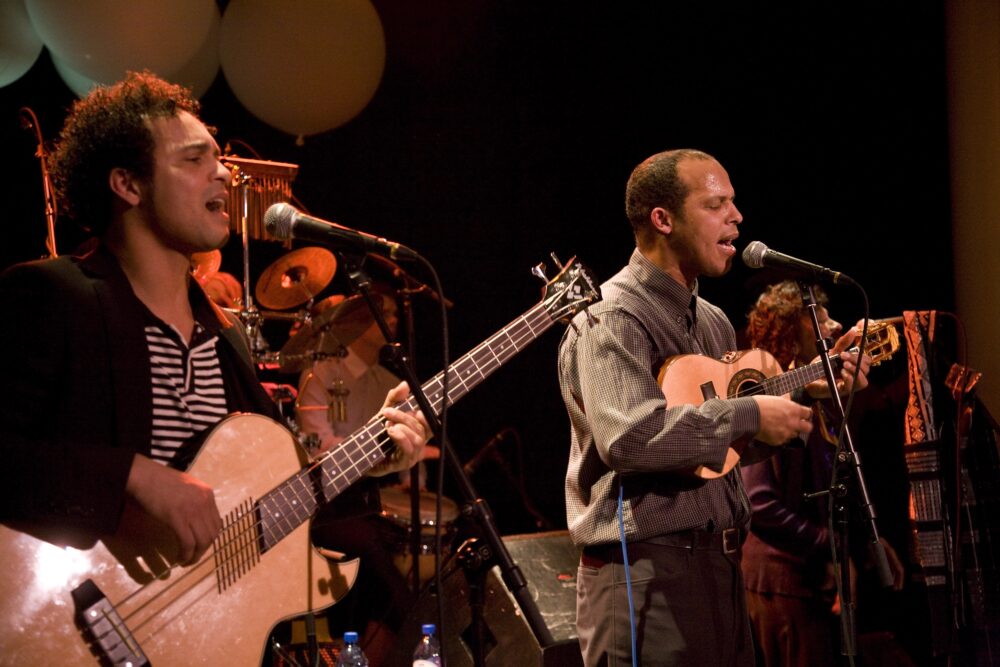
Boi Akih

The band Boi Akih represents a musical movement in which diverse styles from such places as India, Africa, Europe and the Moluccan Islands blend with jazz. Singer Monica Akihari and composer guitarist Niels Brouwer characterise the essence of Boi Akih with an ensemble of song and composition. In search of their musical boundaries, they challenge and at the same time complement one another. Akihari sings not only in English but also in her native language: the language of the Moluccan island Haruku. On their latest CD Yalelol, the group uses a duet-form, and in addition to jazz, their are also Indonesian, Indian, European, West African and Arab influences. On the third album Uwa i (2004), Boi Akih was inspried by music from Bangalore, India. The first self-titled CD of Boi Akih appeared in 1997 and the second one, Above the Clouds, Among the Roots, in 2000. De Volkskrant wrote: "Boi Akih is a world-class band. Daring, adventurous and lyrical are the keywords."
20071029105921

Ruth San A Jong

(Surinam, 1970) won the Third Literature prize of the Kwakoe Festival 2002 with her story ‘The Last Parade’. San A Jong wrote non-fiction for her work for various NGO’s but the Kwakoe prize stimulated her to occupy herself with writing fiction. She is presently working on a collection of short stories. The central theme is death and the way in which people deal with death in Surinam, with all the traditions, beliefs and superstition and the bizar rituals that go with it. Together with storyteller Guillaume Pool she started the Bukutori foundation, which aims at promoting the art of reading, writing and storytelling in Surinam. Since 2008 she is the director of the Schrijversvakschool (School of Writing).
20071129125911

DJ Jairzinho

(1973) in daily life is known by the name of Jaïr Tchong. Right now he works as a project leader world music with Muziek Centrum Nederland and is a member of the supervisory board of Global Dance Lab. In the past he was, among other things, world music programmer at the Melkweg and chair of the commission on internationalisation at the Fonds Podiumkunsten. In addition to being a dj Jairzinho is also a world music journalist. He has an Aruban-Chinese father and a Dutch mother. From the age of fifteen music has been his passion, sussessively punk, new wave, soul, jazz, funk, African, Brazilian and Salsa/Latin. In 2000 he started working in Amsterdam as a dj and freelance journalist with OYE Listen, Het Parool, De Groene Amsterdammer, Nieuwe Revu, Preludium, Ontdek Afrika and NIW. Jairzinho mainly plays afro-latin: all kinds of black dance music have his interest. In addition he increasingly uses East European and oriental music in his eclectic mix. Jairzinho performned among other venues at Oerol, in the Bloemendaalse Republiek, RASA in Utrecht and at the Bimhuis, Bitterzoet, Melkweg and Paradiso in Amsterdam.
20080206101520

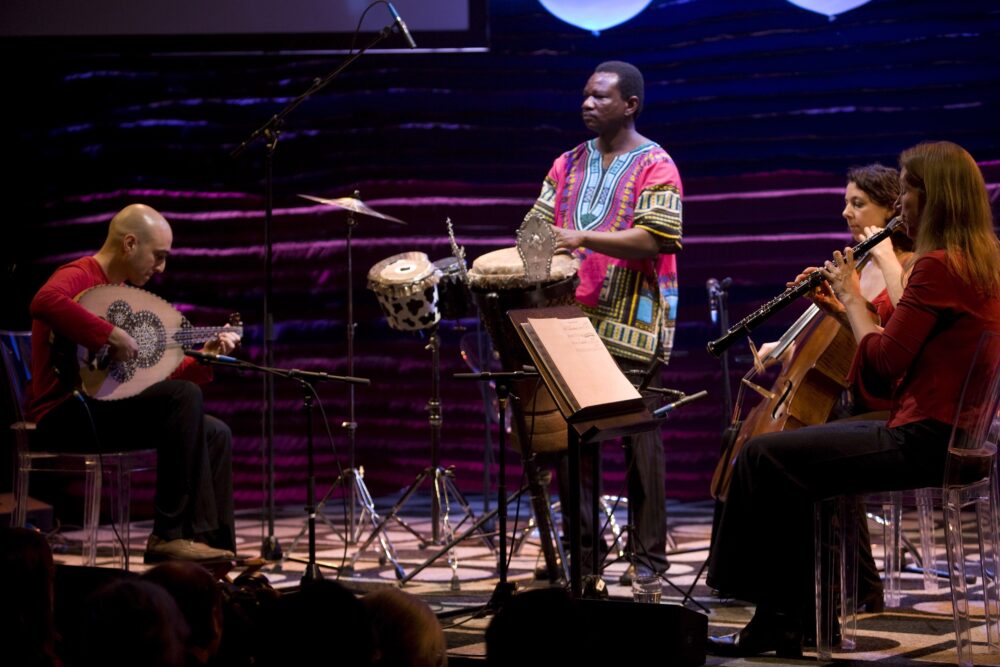
Haytham Safia Qu4rtet

Last year ud player Haytham Safia performed solo at Winternachten, now he plays with a quartet. Beside Haytham (Jerusalem) the group consists of Afra Mussawisade (Iran), percussion, Hanneke Ramselaar, hobo and Eva van de Poll, cello. In 2007 the CD Promises appeared, with classical western, Arab and Persian music, added with other genres, among other things the blues.
20080206153131

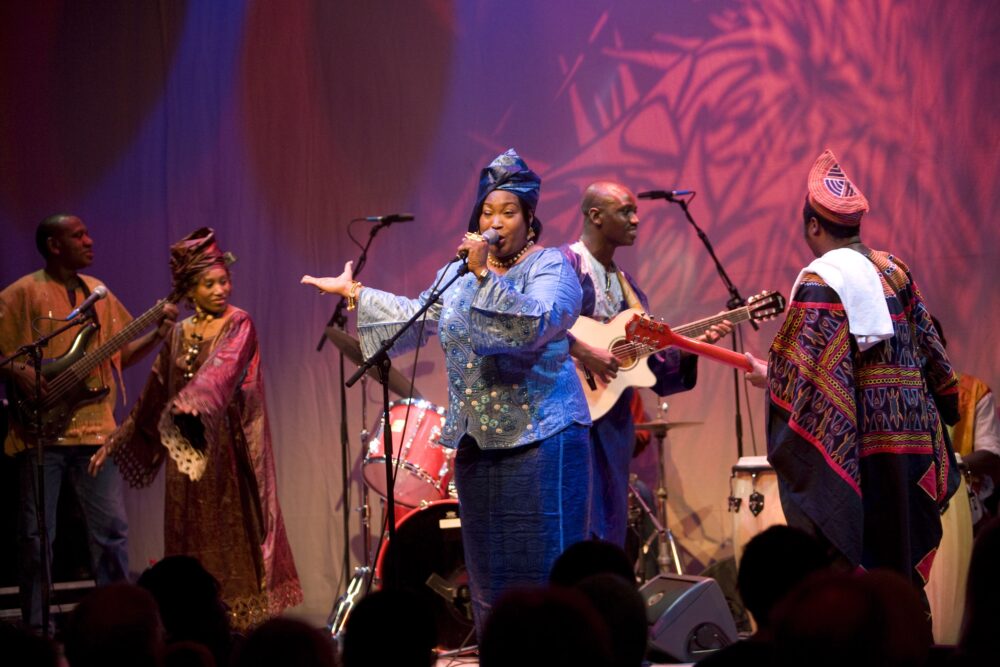
Salimata Diabate

Salimata Diabaté's voice has been characterized as whole, warm and powerful. Her music takes the listener back to the time of the once mighty Mandinka empire, covering a large part of 14th century West Africa. Its history is still sung by griots, a kind of praise poets. Salimata too hails from a family of griots. In addition to traditional repertoire she sings songs she wrote herself.
20080206144130

Rabasa

Rabasa's music is deeply rooted in the Cape Verdian musical traditions, but undeniably has a sound of its own. The multiculti quartet consists of the following members: the four brothers Ortet (João, Jorge, Tó and Angelito), Terezinha Fernandes, Paulo Bouwman (all Cape Verdian), Hans de Lange (Netherlands), trumpet player Kabiné Tagus Traoré (Guinea Conakry), who used to play with Salif Keita in the legendary Malinese group Les Ambassadeurs.
20080207104229

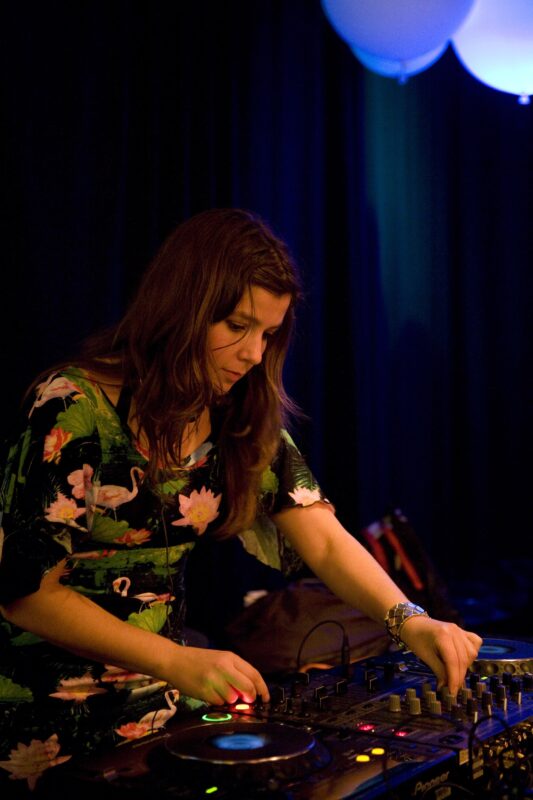
DJ eXes

DJ eXeS is one of the few women succeeding in holding out in the exclusive men's guild of DJs. Brazilian music is her speciality. In addition to Brazilian music she applies herself increasingly to African, Portuguese (lusophone) speaking music.
20080207102941

Paul Scheffer

(1954) worked as a correspondent in Paris and Warsaw before becoming a research assistant at the Wiardi Beckman Foundation. Since 1978 he has written about 200 essays for NRC Handelsblad and Volkskrant newspapers and De Groene Amsterdammer magazine, gaining particular notice in 2000 for The Multicultural Fiasco. In 2007 he published Het land van aankomst (Immigrant Nations), a book that seeks out what really goes on under the surface of multiculturalism. He held the position of Professor of Metropolitan Issues at the University of Amsterdam from 2003 to 2011. Since 2011 he has been professor of European Studies at the Universities of Tilburg and Amsterdam. In 2013 he published Alles doet mee aan de werkelijkheid. Herman de Wolf (1893-1942), his grandfather's biography followed by the essay De grens van de vrijheid (The border's freedom, 2016) in which he states that an open society can only exist by a certain spatial demarcation.
20140910135651 1

Frank Furedi

(1948, Hungary) is professor of sociology at the university of Kent. He wrote among other things Culture of Fear, Paranoid Parenting and Therapy Culture; books on the cultural factors influencing our risk consciousness. In Paranoid Parenting he turns against over-anxious parents, in Therapy Culture he reacts against the image that people are first and foremost vulnerable beings and in Culture of Fear (1997) he argues that western society is increasingly amenable to collective fears. He talks of Anglo-American preoccupations becoming more and and more a wordwide phenomenon. The Netherlands too are influenced by it. “The Netherlands is a relatively civilized country but by degrees it is ripe for all kinds of Anglo-American obsessional neuroses”, says Furedi. “People are afraid of bird flu, mad cow disease, environmental pollution. These are fears which have nothing to do with people's direct experience, but which make up a prominent place in their thinking. These fears are fed continuously, it seems as if we are going from one distaster to the next.” Furedi is especially fascinated by the way we deal with risks. In his books and articles again and again the question is raised why so many people are guided in life by fear. He warns that fear has become an autonomous and destructive force in society, which, owing to alienation from politics, is able to undermine democracy as well.
20071129123423

Tamim al-Barghouti

(1977, Egypt) is a poet and political scientist. He is the only son of the Egyptian writer Radwa Ashour and the Palestine poet Mourid Al-Barghouti. Al-Barghouti is working on a publication on political identity in the Middle East and since 2007 has worked at the University of Berlin as a reseach assistant. He has published four books of poetry: Meejana (1999), Al-Manzar (2000), Qaluli Bethebb Masr (2005) and Maqam Iraq (2005). His poems regularly appear in daily papers and magazines in Egypt, Jordan and Palestine. His poems have won Al-Barghouti various prizes, including the poetry prize of the Regional Cultural Foundation in Marrakesh, Morocco. Characteristic for Al-Barghouti’s style is the use of various dialects in his poems, thus he combines Palestinian, Egyptian and Iraqi dialects in combination with Modern Standard Arabic. After his study in politicfal science and international relations he worked some time for the United Nations in New York and Sudan.
20080124150402

Eva Gerlach

(1948) is a poet. In 1977 she published her first poems in Hollands Maandblad making her debut in 1979 with the collection Verder geen leed, followed by numerous other anthologies, among others Niets bestendiger (1998) and Daar ligt het (2003). She received various literary prizes, the most important one being the P.C.Hooft Prize (2000) for her entire poetical oeuvre, the Jan Campert Prize for the collection Wat zoekraakt (1995) and the Zilveren Griffel (Silver Pencil) for her children's poems Hee meneer Eland (1999). Originally her style was taut and ironical, but throught the years she began using freer verse, her themes remaining virtually unchanged, however: personal life. Gerlach translates poetry from English and Italian. From 1953 to 1966 she lived in Surinam with her parents, attending secondary school. Eva Gerlach is the pseudonym of Margaret Dijkstra.
20080206104744

Maxim Februari

(Coevorden, NL, 1963) was born as Marjolijn Drenth. Besides being a writer, he is an ethicist, an art historian, and a lawyer. Februari understands the art of turning moral dilemmas and legal issues into elegant prose. "It's got to be exciting and entertaining. If you write a pamphlet, no one will read it," he commented. His novel De literaire kring (The Book Club, 2007), on the morals of the Dutch cultural elite, got a very positive reception. From 2001 to 2010 Februari wrote columns for the Volkskrant newspaper. Some of these columns were published in Park Welgelegen - Notities over Morele Verwarring (Welgelegen Park: Notes on Moral Confusion, 2004). In his PhD thesis Een Pruik van Paardenhaar & Over het Lezen van een Boek (A Wig of Horse's Hair & On Reading a Book, 2000), nominated for the Golden Owl Award, he examines the relationship between economics and ethics. Currently he writes a weekly column for opinion page of NRC Handelsblad. Some of these, together with some Volkskrant columns, have been anthologised in Ons soort mensen (Our Kind of People, 2011). De maakbare man (The Makeable Man), notes on transsexuality, was published in 2013.
20121213162959

Fouad Laroui

(Morocco, 1958) in 2013 won  the Prix Goncourt de la Nouvelle for his collection of short stories The Curious Case of Dassoukine's Trousers. Since his debut in 1996 humor has been his weapon against intolerance, both in his novels and in his other work. In his fiction, such as the collection of short stories Poldermarokkanen (2010), the novels Une année chez les Français (2011) and La femme la plus riche de Yorkshire (2011), Laroui describes time and again the collision between North African culture and Western culture. Laroui grew up in Casablanca and studied econometry, mathematics, physics and architecture in Paris. He lectures French literature and Arab culture at the University of Amsterdam.
20181217095441 1

Abdelkader Benali

(Morocco, 1975) is an award-winning writer, poet, playwright and curator. His 1996 debut, Bruiloft aan zee (Wedding By the Sea), was an immediate success. His second novel, De langverwachte (The Long-awaited) won him the prestigious 2003 Libris Literature Award. Benali's subjects vary, but sports and the migrant who never really feels at home are recurring themes. He has written novels about his great passion of running, about his travels, and about migrants' cultural identity (Bad Boy). His work has been published internationally. Recent books include the novel Paradijsvogel boven Hoge Woerd (Bird of Paradise over Hoge Woerd, 2022) and Het andere verhaal (The Other Story, 2022), an essay about his research into 75 years of modern Moroccan art.
20231120143900 1

Lieve Joris

(Neerpelt, 1953), a Flemish prose writer, studied psychology in Leuven, Belgium, and journalism in the Netherlands. Her novel Een kamer in Cairo (A Room in Cairo) tells us about her stay in Cairo, and her awareness that she'll never be part of that strange world. In 1985 she made her first journey to the former Belgian colony the Congo. In Terug naar Kongo (Back to the Congo) (1987) she reflects upon her experiences and impressions there. Later she focused on the Middle East and wrote the book De poorten van Damascus (The Gates of Damascus) (1993). In her book Dans van de luipaard (Dance of the Leopard) (2001) she tells about her second stay in the Congo in 1997, a time of unrest and civil war. In her newest book Op de vleugels van de draak (On The Wings of The Dragon), Joris journeys between Africa and China. Lieve Joris is a committed observer and knows like no other how to portray a post-colonial Africa. Her work has been awarded repeatedly, both in Flanders and in France.
20071129153838

Geert Linnebank

(The Hague, 1956) grew up in Brussels. In 1983 he worked as an EU correspondent with Reuters' in Brussels. From 2000 to 2006 he was editor-in-chief of Reuters' in London, heading an international editorial staff of reporters, photographers and tv producers. In this period he was among other things responsible for Reuters' reporting of the worldwide effects of 9/11, such as the wars in Afghanistan and Iraq, and for the founding of Reuters' News and Data Centre in Bangalore, India. In his career he has travelled widely in Asia, the Arab world and other areas where Reuters’ reporters are met with censorship on a daily basis. Right now he chairs the Reuters' Foundation.
20080206143454

Saskia de Jong

(1973) is a "hyper-aware poet" (Piet Gerbrandy, Volkskrant). Her 2004 debut zoekt vaas (looks for vase) was nominated for the C. Buddingh Prize. According to the jury, she writes "enigmatic poems from which words and sometimes even entire phrases seem to have disappeared. [...] A stubborn language that one doesn't often hear and that does not leave one in peace." Her second collection, resistent (resistant, 2006) was followed by De Deugende Cirkel, gedichten en knipsels voor kinderen (The Virtuous Circle: poems and cut-outs for children, 2010). She also creates video installations in collaboration with visual artist Ine Lamers. In 2019, her poetry collection Het jaagpad op en af (Up and down the towpath) will be published.
20181119104222 1

Rudi Wester

(Leeuwarden, 1943) until 2009 headed the Institut Néerlandais in Paris. Previously she headed the Dutch Literary Production and Translation Fund. In that capacity she has given Dutch literature abroad a face. Wester studied French at the Amsterdam Free University. For a long time she reviewed French literature for the weekly magazine Vrij Nederland. Annually she anthologizes the best Dutch and Flemish travel stories. In 2000 the French government made her Officier des Arts et des Lettres; in 2001 she was made a Knight in the Order of Orange Nassau.
20111215102658

Gabeba Baderoon

(South Africa, 1969) is the author of The Dream in the Next Body (Kwela/Snailpress, 2005), The Museum of Ordinary Life (DaimlerChrysler, 2005), and A Hundred Silences (Kwela/Snailpress, 2006). In 2005 she received the DaimlerChrysler Award for South African Poetry and held the Guest Writer Fellowship at the Nordic Africa Institute, the second person after Ama Ata Aidoo to receive this honour. Her poetry appears in the anthologies Worldscapes (Oxford University Press, 2005), Ten Hallam Poets (Mews Press, 2005), Voices from All Over (Oxford University Press, 2006) and Birds in Words (Umuzi/Random House, 2006). Her poetry has been published in journals in South Africa, the United States and Britain, and in translation in Karavan (Stockholm) and Adamar (Madrid). Her fiction appears in Chimurenga magazine and Twist, a short story anthology (Oshun, 2006). Gabeba is also a scholar, and has written for the media.
20071129113949

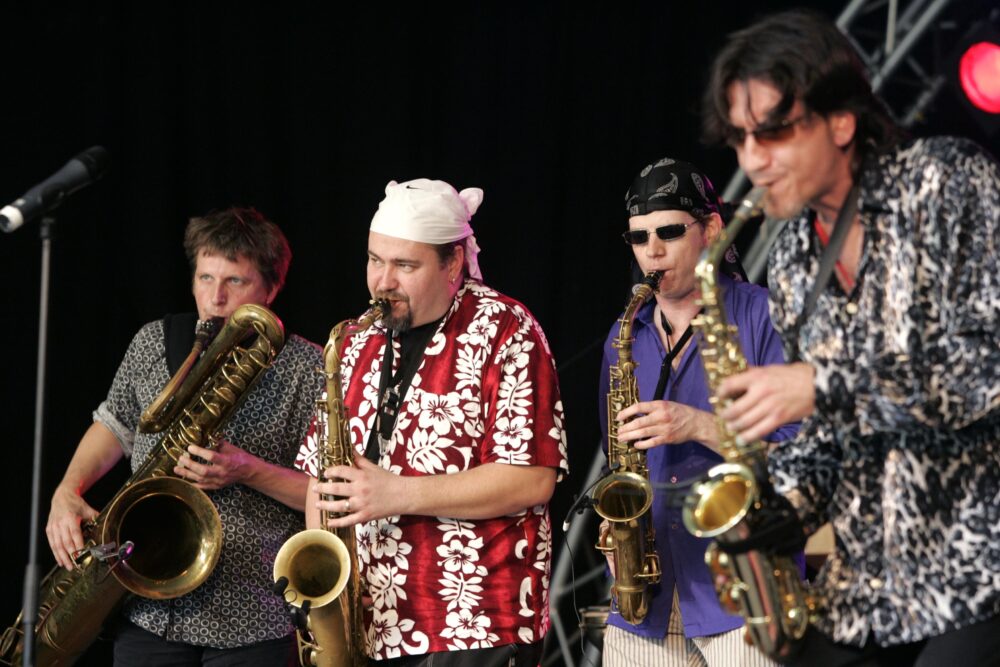
Carlama Orkestar

The Serbian word ‘Carlama’ refers both to a kind of wild dance and can also mean: exuberant party. The collective combines the rich Serbian brassband tradition with music from the enitre Balkan region. The musicans are special: in addition to percussion the whole saxophone family is represented: from soprano sax to bass sax.
20071025110527

Tsead Bruinja

(Rinsumageest, 1974) made his debut in 2000 with Frisian volume of poetry De wizers yn it read (The Needles in the Red). In 2008 a bilingual anthology appeared of his Frisian poetry, De Berte fan it swarte hynder (The Birth of the Black Horse). Bruinja translated the poems himself, and in many instances revised them. In this volume he evokes his youth in the Frisian countryside, whereby the illness and death of his mother plays a prominent role. Bruinja edited various anthologies, among others Droom in blauwe regenjas (Dream in a Blue Raincoat; 2004), a compilation of Frisian poems, Klotengedichten (Bollocks Poems; 2005, poetry about the scrotum) and Kutgedichten (Cunt Poems; 2005, on the female genitals). In 2007 the volume Bang voor de bal (Fear of the Ball) appeared. Tsead Bruinja wrote poetry reviews for newspapers, magazines, and radio. He combines his poetry readings with live music, such as flamenco, trance and hiphop and frequently interviews other poets before an audience.
20081202104718

Ahmed Ziani

(Morocco, 1954 ) was born in the North Moroccan Reef. He emigrated to the Netherlands in 1979 to become one of the most well-known poets of the Moroccan community here and in Belgium. Ziani is a pioneer in the stuggle for recognition of Berber language and culture. In 1983 he published In steen zal ik schrijven, (In Stone I Shall Write), the first book of poetry to appear in Tamazight (with a Dutch translation). In 1997 it was followed by Jubelzang voor de bruidegom (Song of Joy for the Bridegroom). Migration and identity are important themes in his poems. Also he intertwines in his poetry the nature and the popular culture from his youth with the influences he underwent in the Netherlands. Ziani moved to Morocco in 2003, living in Nador. Soon the anthology Forgetting to Die will appear.
20071203114035

Tuncay Çinibulak

(Turkey, 1970) has been editor-in-chief since 2005 of the Dutch/Turkish business & cultural magazine TULPIA. Previously Çinibulak worked as a journalist for some time with several Dutch television companies and daily newspapers as well as writing columns for Metro and the Amsterdamse Stadsblad. Çinibulak is also a poet. His short stries and poems have been collected in Een hand uit de nacht (A Hand from the Night, 2002) and in Het land in mij. Nieuwe Verhalen van Jonge Schrijvers op de Grens van Twee Werelden (The Country Within. New Short Stories by Young Writers on the border of Two Worlds, 1996). He has also published his poems in literary magazines, Rood Koper, among others. Çinibulak has read a great deal from his own work, particularly during remembrance day 2002. Çinibulak has lived in the Netherlands since 1980.
20071129121957

Margot Dijkgraaf

(The Netherlands, 1960) is a literary critic, writer, curator, interviewer, debate leader and "ambassador between France and the Netherlands in the field of literature", as a French ambassador once said. She has been writing about literature for some 30 years, mainly for the NRC daily. She published books on French and European literature, on Hella S. Haasse and Cees Nooteboom. Her In de voetsporen van mijn grootvader (2021) is an autobiographical search for her literary genes. Before that, she published Met Parijse pen. Literaire omzwervingen (in collaboration with photographer Bart Koetsier, 2020), which takes readers to Paris for walks in the footsteps of famous Dutch and French writers. She was joint artistic curator of the Netherlands' Guest of Honour role at the 2024 Leipzig Book Fair with German journalist Bettina Baltschev.

Go to the website of Margot Dijkgraaf
Instagram: @margotdijkgraaf
20231106160244 2

Asis Aynan

(Haarlem, NL, 1980) studied philosophy at the University of Amsterdam. Aynan, the son of Moroccan immigrants, is an active advocate of Berber culture. His debut Veldslag en Andere Herinneringen (Battle and Other Memories) was published in 2007, about his youth or, as he calls it, his "Catholic-Islamic-Berber background". Aynan is the creator of the Berber Library, a series of classics from Berber countries translated into Dutch. He further wrote Ik, Driss  (I, Driss, together with Hassan Bahara), the short-story collection Gebed zonder eind (Endless Prayer, 2014) and Linoleumkoorts (Linoleum Fever, 2019). Aynan works as a teacher at Hogeschool van Amsterdam; his articles have appeared in the NRC, Het ParoolFolia and Trouw.
20080131132856

Ida Does

(Paramaribo) debuted in 2008 as director with the documentary Trefossa Mi a No Mi, about the Surinamese poet Trefossa (1916-1975), pioneer in the use of Sranantongo in poetry. The documentary was the opening film of the film festival The Backlot in Suriname and won the audience award at the Africa in the Picture Film Festival in Amsterdam (2010). Does has a long career behind her as editor-in-chief and journalist for various media in the Netherlands, Suriname and Aruba. In the 1990s she was editor-in-chief of Mutyama, a Surinamese magazine for culture and history. She also published in De Journalist, het Algemeen Dagblad, Vrij Nederland, De West and Mokro. In Aruba she headed the editorial staff of the daily Amigoe Aruba. In addition she worked for VPRO radio (De Avonden) and was a correspondent for Wereldnet (radio). For years she worked with Omroep West as an editor-in-chief of various television programmes. For some years now she has been a self-employed film maker and producer.
20101122125557

Elsbeth Etty

(Hulshorst, NL, 1951) received the Anne Vondeling Award for political journalism in 2008, owing to her sharp analyses of social problems. She is a journalist in the widest sense of the word. Besides being an editor and columnist with the NRC Handelsblad newspaper, she makes frequent appearances on radio and TV. In 2007 she debuted as a novelist with Maak jezelf maar klaar (Go Get Yourself Off), in which one of the characters from Harry Mulisch's The Discovery of Heaven figures as a main character. Etty obtained her Ph.D. with distinction from Utrecht University with a biography of Henriëtte Roland Holst, Liefde is heel het leven niet (Love Is Not All of Life, 1996). Her newspaper columns appeared in four different books. Her reviews were compiled in Dames gaan voor - Van Hella Haasse to Connie Palmen (Ladies First: From Hella Haasse to Connie Palmen, 1999). Etty is a special lecturer in Literary Criticism at the Free University in Amsterdam, and is now at work on a biography of the late Dutch poet and songwriter Willem Wilmink.
20100201124623

Pieter Steinz

(Rotterdam 1963 - Haarlem 2016) in 2010 published Grote Verwachtingen. Opgroeien in de letteren in 25 schema’s (Great Expectations. Growing up in Literature in 25 Charts). He did the same in Luisteren & cetera, (Listening etc) about 25 1970s pop albums. Somewhat earlier Macbet heeft echt geleefd (Macbeth Really Existed) appeared, on places where literary heroes used to live. In Verleden in verf (Past in Paint, 2011), Steinz sketches Dutch history in forty paintings. Steinz became an art editor with NRC Handelsblad in 1989. From 2005-2011 he headed the bookpages of that paper. Steinz studied ancient history and English. Earlier he wrote, among other books, Klein ABC van de wereldliteratuur (Concise ABC of world literature; 2008), Het web van de wereldliteratuur (The World Literature Web; 2007) and Lezen op locatie (Reading on Location; 2003), sixty maps on which he identifies where masterpieces of literature are set. In 2010 he published De Duivelskunstenaar (The wizard), a journey through Europe in search of Faust. Since 2012 Steinz has been head of the Dutch Literary Fund. He died in august 2016.
20111103145813

Jonas Hassen Khemiri

(Sweden, 1978) has a Tunesian father and a Swedish mother. He studied literary theory in Stockholm and economics in Paris. In 2003 he made a successful debut with the novel Ett öga rött which was published in a Dutch translation in 2007 (A camel without a hump). In it an Arab pupil struggles with his identity in Stockholm and sets his own cultural background against the social reality around him. The novel was adapted for film. Khemiri's first play, Invasion!, gives an image (of the abuse) of the fear of the other. It was successfully staged in Sweden, Germany and France. Khemiri's second novel, Montecore, is being translated in Dutch.
20080206151522

Osama Abdulrasol

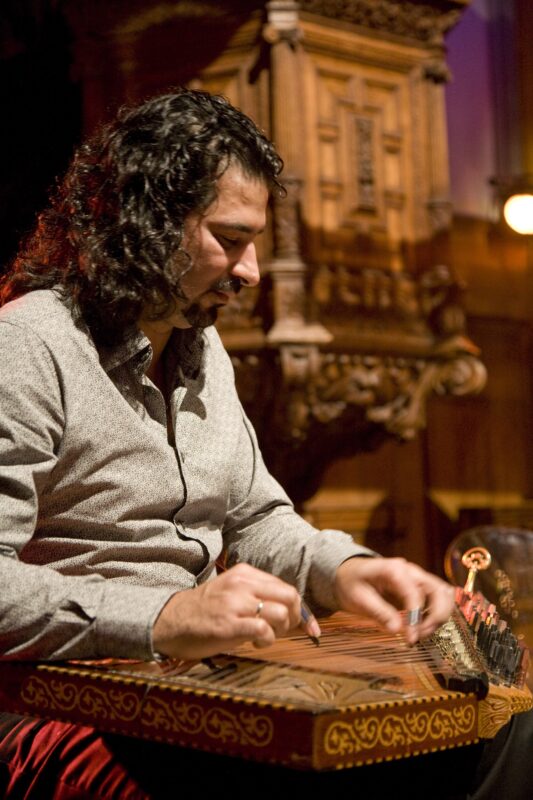
(Iraq, 1968) studied both western music (classical guitar) in England and eastern music (ud and qanun) in Iraq. In addition to playing the guitar, the ud and the qanun he is a composer in his own right, working with the group Melike, of which bass player Henk de Laat is also a member.
20080122094456

Anne-Sophie van Neste

(1956, België) studied History in Brussels. She is communication officer at the International KunstenFestivaldesArts in Brussels and various other cultural events and organisations in the city.
20080206101451

Ayada Ghamhi

(1980). Won the l-Hizjra Literature prize 2006 for prose in the category 26 years plus. She studies Human Resources Management at the Hogeschool Rotterdam. Ze speaks Berber and Arabic. She writes in Dutch.
20080206143917

Mohamed el Hadaoui

(Morocco, 1973) was born in Tizi Ousli, a small village at the foot of the Rif mountains. He writes his poems in Tamazight and Arabic, under the name Asemqar. His poems have been awarded twice with the El Hizjra literature prize.
20080108093528

Sidney Kock

(Aruba) worked with the Aruban news programme of TeleAruba after studying at the Journalism School in Utrecht. Back in the Netherlands he worked as a editor with the KRO programme Echo on Radio 1. In addition he worked for a long time as reporter for the NPS programme Tambu. Since 1 November 1996 Kock has been working with the Office of the minister plenipotentiary of Aruba. As a communications and PR officer he is among other things spokesperson of the Dutch Aruba office; maintaining contacts with both the Dutch and the Aruban press and responsible for the newsletter of the Dutch Aruba office, the Noticiero.
20080102104819

Igma van Putte

is a poet and translator. Together with Florimon van Putte she compiled the Complete Papiamento-Dutch Dictionary, published in September 2005, followed in 2006 by the Dutch-Papiamento volume.
20071129131953

Quito Nicolaas

(Aruba, 1955) studied political science and law at the University of Amsterdam. In 1980 his poem E Dia di Mañan appeared, followed by many publications such as the poetry collection Politico (1990), Illucion Optico (1995) and the poem Ser Nihilo (1998). His collection of poems Destino appeared in 2000. In 2001 his first short story, Un Pasco Tristo, was published. Another poetry collection, Gerede Twijfels (Certain Doubts), appeared in 2002. In 2003 his novel Sentencia sin Proceso appeared. Nicolaas - who sees himself first and foremost as an Aruban writer - is chairman of the board of the Antillean and Aruban literary organisation Simia Literario. Since April 2001 he has been attached as a reviewer to the weekly publication Contrast. He mostly comments on novels and poetry collections written by mainly non-indigenous writers.
20050301220936

Ronald Severing

(1949) is director of the Fundashon pa Planifikashon di Idioma (Foundation for Language Planning) on Curaçao. Its goals is to promote the relevant languages of the community and to regulate the state of affairs of language. Severing studied Dutch in Nijmegen, sociolinguistics and applied linguistics in Tilburg, and obtained his doctorate with a thesis on literacy and successful teaching on Curaçao. For years he has been working at all levels of education, both in the Netherlands and in the Netherlands Antilles. He is editor of teaching methods of Papiamentu for primary schools on Curaçao, like Mosaiko, Trampolin and Cristal. In addition he wrote about the writers Cola Debrot and Frank Martinus Arion.
20060105153056

Raoul Heertje

(Bussum, 1963) as a stand-up comedian, tv maker and writer likes to mop the floor with – in his eyes – often stupid politicians and journalists. In 2009 he began his own talk show with VPRO, Heerlijk, eerlijk Heertje (delicious, honest Heertje). In this programme he showed that many seemingly spontaneous processes in tv programmes are actually precooked. In 1990 Heertje introduced the stand-up comedy in the Netherlands with the launch of the Comedytrain. He is also the initiator of Comedy Café Toomler in Amsterdam. Heertje is especially known as team captain of the tv programme Dit was het Nieuws (the Dutch version of Have I got news for you) cooperating sincs 1995. In addition he writes. He wrote columns and interviews for among others Vrij Nederland, Sportweek, NRC Handelsblad and Het Parool, which were published in book form. In 2009-2010 he made the VPRO programme Wintergasten (Winter guests). Raoul Heertje also performed in foreign comedy clubs and was a guest in various foreign tv programmes, such as Ruby Wax’ show. Right now he is working on a new book Circus Nederland (Circus the Netherlands), on the media and manipulation, which will appear in 2011.
20091013110245

Henk de Laat

Bass player Henk de Laat studied at the Rotterdam Conservatorium and has played with, among others, Shirley Bassey and Denise Jannah. Right now he is a member, with Osama Abdulrasol, of the group Melike.
20080110184500

Nelleke Noordervliet

(Netherlands, 1945) writes novels, stories, essays, lectures and columns with a strong historical bent. She debuted with 1987's Tine of de dalen waar het leven woont (Tine, or the Valleys Where Life Lives), a fictitious biography of 19th-century Dutch writer Multatuli's first wife. Her book De naam van de vader (The Name of the Father) won the 1994 Multatuli Prize. In 2002 she wrote Pelican Bay, about slavery in the Caribbean and the Netherlands. Her essay collection Schatplicht (Tribute) appeared in 2013, and her 2016 novel Aan het eind van de dag (At the End of the Day) is simultaneously a portrait of a career woman and a snapshot of the second half of the 20th century. De val van Thomas G. (The fall of Thomas G.) tells about the publisher of a controversial book. Noordervliet's body of work was awarded the 2018 Constantijn Huygens Prize.
20181203095828 1

Yra van Dijk

(1970) is a critic who studied Dutch language and literature. She used to work for Volkskrant and nowadays reviews French literature and Dutch non-fiction for NRC Handelsblad. She publishes essays an criticism in among others De Gids, Literatuur, Parmentier, Raster and Yang. In 2005 she wrote her Ph. D. dissertation on the typographical white modern poetry, published in 2006 entitled Leegte die ademt (Breathing Emptiness). In addition to writing journalistic work she lectures contemporary Dutch literature at the University of Amsterdam.
20080206152216

Paul van der Gaag

(Netherlands, 1958) has produced and presented the VPRO radio programme OVT since 2002, a two-hour show about the historical roots of current events as well as newly released historical books, films, commemorations, and anything else related to history. The show features live interviews, reportage, columns and a weekly documentary during the last half hour. He was already linked to OVT since 1992 as a programmer and previously freelanced for other national Dutch broadcasters such as VARA and IKON.
20120204162040

Adriaan van Dis

(The Netherlands, 1946) grew up in a family with a past in the Dutch East Indies. He draws on these experiences in several of his works such as My Father's War (1995), Repatriated (2002) and in Naar zachtheid en een warm omhelzen (2023). Van Dis became well known via his literary television programme Here is... Adriaan van Dis (1983-1992). In addition to novels he has written novellas, travelogues, essays and plays. He presented TV documentary series and his podcast Van Dis Ongefilterd. He has received the Constantijn Huygens Award for his entire body of work. Recent publications are the collection Vijf vrolijke verhalen (2021), the novel KliFi, woede in de republiek Nederland (2022) and the essay De kolonie mept terug: over witte arrogantie en voortschrijdend inzicht: een denkoefening en leesreis (2024)During the Writers Unlimited Festival 2026, Van Dis will be the main interview guest on Saturday afternoon, 24 January, following the publication of his new book Alles voor de reis (Everything for the Journey), and on Sunday morning, 25 January, he and interviewer Simon Dikker Hupkes will record a new episode of his podcast series Van Dis Ongefilterd (Van Dis Unfiltered) live with an audience.

Go to website of Adriaan van Dis
20251014161120 3

Bram Peper

(1940, Haarlem) is a former Dutch politician (Dutch Labour party). He was mayor of Rotterdam and Home Secretary. He studied social science at the University of Amsterdam. He got his Ph.D. in 1972 in political and social science with a dissertation entitled Formation of Welfare policy: Evolution and Evaluation of Community Work. He was professor of sociology at the Erasmus University in Rotterdam. From 1982-1998 he was mayor of Rotterdam. In 1998 Peper became Home Secretary in the 2nd Cabinet of prime minister Wim Kok. In 2000 he resigned. From 2002 to 2004 he was professor of Public Management at Nyenrode University. Bram Peper published among other thnings: Een dolend land: Over de politieke architectuur van Nederland (oratie, 2002) and Over klefheid en lafheid: Waarheidsvinding, personalisme en consumentisme (2003).
20071114162052

Ester Naomi Perquin

(Utrecht, NL 1980) during her training at a creative writing school Perquin worked as a warder in a Rotterdam prison. She made her debut in 2007 with the collection of poetry Servetten Halfstok Napkins Half-mast, which was nominated for the C. Buddingh’ Prize and ultimately awarded the debut prize of Het Liegend Konijn (the Lying Rabbit), among others. The jury praised the persistent mastery of metre and rhythm and stressed the scope of her subject-matter. Her next collection, Namens de ander On Behalf of the Other was awarded the Jo Peters Poetry Prize and the J.C. Bloem Award. She is a columnist for the weekly De Groene Amsterdammer and VPRO De Avonden radio programme and is on the board of editors of Tirade. She is the Rotterdam 'city poet' and actively involved as a poet, producer and interviewer at literary events in that city. In her third collection, Celinspecties (Cell Inspections), she goes back to her past as a prison warder. It appeared early 2012 and has been nominated for the VSB Poetry Award 2013.
20121112115226

Gerrit Jan Wolffensperger

(1944) is a former politician, former parliamentary leader of D66 and former chair of the Dutch broadcasting authority. From 1998-2003 he chaired the NOS, later renamed Public Broadcasting. He also chaired the Dutch Photo Institute and World Press Photo. Wolffensperger studied law and economics and was a photographer. In 1973 he became a lecturer at the law faculty of the University of Amsterdam. From 1986 to 1997 he was an MP for D66, the last three years as parliamentary leader.
20071120093502

Willem

(pseudonym of Bernard Holtrop, 1941) is a cartoonist. Holtrop lives in France, where he is known for his sharp political drawings, which appear daily in the leftwing newspaper Libération. Having worked as a cartoonist in France for over thirty years, he still supplies weekly political cartoons to HP/De Tijd. In addition, the weekly Vrij Nederland publishes his cartoons on a regular basis. After art school in Arnhem and Den Bosch Holtrop made cartoons for various magazines, including the student magazine Propria Cures. In the 1960s he became the in-house cartoonist for the magazine Provo. In 1966 a cartoon in which queen Juliana prostituted herself caused a scandal. Between 1993 and 2002 he travelled to among others the Ivory Coast, the Baltic states, New Hampshire, Moscow and Yaoundé, the capital of Cameroon, where he wrote and drew diary-like reports, commissioned by Libération (see his book Razende Reporter - Raging Reporter, 2002). In France he was honoured with the ‘Medaille d’Honneur’. In Holland he recieved the Stripschapprijs for his entire oeuvre (2000) as well as the Inktpotprijs (2006, 2007).
20071126111348

Elif Shafak

(France, 1971) is an award-winning British-Turkish novelist and storyteller. She has published 21 books, 13 of which are novels and her books have been translated into 58 languages. The Island of Missing Trees was a finalist for the Costa Award, British Book Awards and a Reese Witherspoon Book Club Pick. 10 Minutes 38 Seconds in this Strange World was shortlisted for the Booker Prize and RSL Ondaatje Prize; and was Blackwell’s Book of the Year. The Forty Rules of Love was chosen by BBC among the 100 Novels that Shaped Our World. The Architect’s Apprentice was chosen for The Queen’s Reading Room. Shafak holds a PhD in political science and she has taught at various universities in Turkey, the US and the UK, including St Anne's College, Oxford University, where she is an honorary fellow. She also holds an honorary Doctorate of Humane Letters from Bard College. Shafak is a Fellow and a Vice President of the Royal Society of Literature and has been chosen among BBC’s 100 most inspiring and influential women. An advocate for women's rights, LGBTQ+ rights and freedom of expression, Shafak is an inspiring public speaker and twice TED Global speaker. She contributes to major publications around the world and she was awarded the medal of Chevalier de l’Ordre des Arts et des Lettres. In 2024, Shafak was awarded the British Academy President's Medal for "her excellent body of work which demonstrates an incredible intercultural range". Her website can be found at www.elifshafak.com and her Substack is called "Unmapped Storylands".
20241003171839 4

Peter-Jan Wagemans

(1952) is one of the Netherlands' best known composers. In his work Wagemans aims at developing and renewing the European tradition. In the last ten years Wagemans’ work has been performed by virtually every Dutch orchestra and musical group. In February 2007 his opera Legende (Legend) had its premiere, and was reviewed favourably. The libretto of this opera is based on the 19th century fairy-tale of Meester Prikkebeen (Master Pricklylegs). In 2005 his work Gravity Music was performed, written for the Royal Concertgebouw Orchestra. In addition Hagemans has composed work for the Schönberg Ensemble as well as a piano cycle for pianist Tomoko Mukaijama. In 1999 he was recipient of the ANV-Visser-Neerlandiaprijs and in 1990 won the Matthijs Vermeulenprijs. Wagemans lectures Composition and Theory of Music at the conservatory of Rotterdam and from 2000-2006 he worked as a musical programmer with the Holland Symfonia Orchestra.
20080110185012

Ruben Severina

(Curaçao, 1956) For years was the face of the Antillean community in the Netherlands. He came to the country in 1989 to study and wanted to return afterwards. However, he stayed because of his young family and found a new mission: taking care of the interests of Arubans and Antilleans in the Netherlands. With the Splika foundation he dedicated himself to the promotion of Papiamentu, the language that he also teaches. Subsequently he chaired MAAPP (Movimentu Antiano i Arubano pa Partisipashon Politiko), the platform for the social participation of Antilleans and Arubans in the Netherlands. When he resigned on 1 March 2009 he received the MAAPP award Mi ta yuda, a new medal which will be awarded on Severina's birthday to people who have dedicated themselves to the Antillean and Aruban communities. For some time Severina served on the town council for the Dutch Labour Party in the town of Zoetermeer and now chairs HAAB (The Hague Antillean Aruban Board).
20050223215954

Geert Mak

(Vlaardingen, NL, 1946) is a lawyer and writer. After a series of books on Dutch and world history he made his 1991 breakthrough with Hoe God verdween uit Jorwerd (How God Disappeared from Jorwerd), about the demise of European peasant culture. Eight years later he published De eeuw van mijn vader (My Father's Era), a 20th-century history of the Netherlands, partly based on his own family history. In 1999 Mak travelled across Europe, writing short daily reports for NRC Handelsblad newspaper. These travels formed the basis for his international best-seller In Europe, which was made into a 35-part TV series; a theatrical interpretation runs at the NTGent theatre until April 2016. In 2013's Reizen zonder John (In America: Travels with John Steinbeck), Mak follows in the late author's footprints to look for remaining bonds between Europe and the US. Mak was an acclaimed journalist, lecturer in constitutional and immigration law, and professor of urban issues. In 2015 he won the Golden Quill award for his engagement with national and international history and current events.
20131016135700 1

Hassan Daoud

(Lebanon, 1950) after his study of Arabic Literature Daoud worked as a journalist during the civil war in Beirut, among other things as a correspondent for the Arabic newspaper al-Hajaat, published in London. Right now he is executive editor of the cultural pages of the daily paper al-Mustakbal. In addition to literature and culture he occupies himself intensively with daily events in Lebanon and the Middle East. His commentaries on social and political events appear in both Arab and European papers, the Neue Zürcher Zeitung being one of them. In his literary writing Daoud refuses to concern himself with the ‘rhetoric of heroism and tragedy’ of many authors writing about the Lebanese civil war. Instead he aims his attention on the microcosm. Most of his novels are set in Beirut. The House of Mathilde (1983) depicts the life of muslims and christians in an apartment building in Beirut. Daoud, who himself grew up in a home with muslims, christians, Druzes and immigrants from Russia and Armenia, portrays a highly detailed picture of the daily life of the tenants. Between the lines the backgrounds of recent Lebanese social and political history are made visible. Daoud has published two collections of short stories and nine novels.
20080206105627

Mathijs Deen

(Hengelo, NL 1962) is a radio journalist and a writer. His most recently published book is De Wadden (The Frisian islands; 2013), a poetic history of the Frisian islands. His book of short stories Brutus heeft honger (Brutus is hungry, 2011) was nominated for the AKO Literature Prize. Eating being the leitmotiv, Deen jumps through world history. The forty-four historical stories are fine miniatures of scarcely one and a half page long. After having studied Dutch in Groningen Deen worked for Radio Noord for some years. His radio columns from those days were collected in two publications. Since 2001 Deen has been programme maker with VPRO radio, hosting the historical radio programme OVT. A number of historical documentaries which he made for VPRO radio has been published as an audiobook. The radio series De lange weg naar Darwin (Long road to Darwin) appeared on cd and as a podcast. Deen was programme coordinator of the Winternachten Festival between 2009 and 2011.
20091203105902

Henk Pröpper

as of December 2011 is director of De Bezige Bij publishing house. Before that he headed the Nederlandse Letteren Fonds (a merger of the Nederlands Literair Productie- en Vertalingenfonds and the Fonds voor de Letteren), the NLPVF and the Institut Néerlandais in Paris. As director of the Dutch Literary Fund in recent years Pröpper further enlarged a colossal network among writers and foreign publishers. He wrote numerous essays and articles on both Dutch and international literature. He also worked as a journalist, literary critic, editor and editor-in-chief of various cultural television programmes.
20120118163725

David Van Reybrouck

(Belgium, 1971) is an author, historian and archaeologist, known for his multifaceted contributions to literature and intellectual discourse. He is currently Philosopher Laureate of the Low Countries. Upon his appointment, he published De wereld en de aarde (The World and the Earth, 2025), in which he makes a groundbreaking proposal to radically broaden our thinking—and our politics. For the greatest security issue of our time is not the world with its mutual conflicts, but the earth, which is becoming increasingly disrupted. His oeuvre covers a range of genres, including historical non-fiction, poetry, and theater. Among his best-known works are Congo (2010), about the country's bewildering history, and Revolusi (2020), which places Indonesia's struggle for independence in a global perspective through eyewitness accounts. In addition to his literary work, Van Reybrouck is known as ‘one of Europe's leading intellectuals’ (Tagesspiegel), whose ideas relate to themes such as democracy, climate, and colonialism. He regularly publishes opinion pieces in international publications. 

Go to the website of David Van Reybrouck
Instagram: @david.vanreybrouck
20251015162805 1

Youssouf Amine Elalamy

(1961, Morocco) acquired fame with his novel Les Clandestins (The Clandestines; (2000), which was translated into Dutch. In this story he gives a face to the Moroccans who in a last desperate effort try to reach Europe and lose their lives. Elalamy belongs to the new crop of young writers who grew up after Moroccan independence from France. The Moroccan identity forms an important leitmotiv in his work. His collection of short stories Tqarqib Ennab (Rumours) from 2004 is the first book fully written in darija, the Moroccan dialect of Arabic. ‘To show it is a real language, alive and creative,’ he said about it in an interview with Trouw. Elalamy has three novels to his name, of which Les Clandestins was awarded the Grand Prix Atlas 2001. In 2004 he published a series of portraits of Moroccans in Morocco (Miniatures). Apart from being a writer Elalamy is a visual artist and a teacher of style and media at the university of Kenitra. In 2009 he made the literary installation Nomad. In Morocco sharp analyses of his literary collages have led to censorship of his visual art. His novels have been translated into Dutch, Arabic, English, Spanish and Italian.
20080908143303

Sadik Yemni

(Istanbul 1951) came to the Netherlands in 1975, found a job as a bridgeman for the NS (National railways) and during a period of seven years developed into a writer. Since then he has written various stories, plays, literary detectives and novels, which have been published in Turkish - the language in which he writes - as well as in Dutch. For instance : De roos van Amsterdam (The rose of Amsterdam) , De amulet (The amulet), De vierde ster (The fourth star), Muhabbet Evi (2006) and Durum 429 (2007) appeared in Turkish.
20050224132752

Asli Tohumcu

(Germany, 1974) is a Turkish writer and journalist. In invitation of the newspaper AD/Haagsche Courant and Kosmopolis Den Haag she lives as a guest writer in The Hague to write articles on the Turkish migrants in the city. She was born in Leverkusen and moved to Turkey when she was five. Tohumcu schrijft literary reviews for Turkish newspapers and makes a culture programme on Turkish state television. She published a collection of short stories (Abis, 2003) and the novella Yok Bana Sensiz Hayat (No Life without You). The latter will be published soon in English translation.
20071104225241

Between fear and hope. Part 1: science

Information

Date and time Saturday 19 January 2008 20:00 tot 21:00 uur
Location Theater aan het Spui - grote zaal
20080206143901
A test tube? A revealing line of poetry? Moving music? In a programme lasting all evening in the main hall of the theatre, prominent figures from the world of art, culture and science talk to Michaël Zeeman about the question: what do they see as the imagination of hope? The guests each bring an image they derive hope from and illustrate their choice. A tryptich with six modern words, images and sounds of hope – which one will convince you?

Part 1 science: for a long time science was at the centre of of the faith in progress. But can it still fulfil its glorious role? Louise O. Fresco, writer (of among other books The Utopists) and brightest person in in ther Netherlands, opens the programme with a column. Together with Ronald Plasterk, natural scientist and Dutch Minister of Education, she will try to answer the question as to what extent science can still be a source of optimism. In Dutch. Meer details bekijken

Forbidden words

Information

Date and time Saturday 19 January 2008 20:00 tot 21:00 uur
Location Theater aan het Spui - kleine zaal
20080206144036
This summer the Syrian writer and film maker Khaled Khalifa again got to know the limits of the freedom of expression in his country. In praise of Hatred, his novel about the Syrian agression against the muslim brothers (25 years ago), was banned in Syria. In 2000 his novel The Gypsy Notebooks suffered the same fate. In this programme he talks to Lieve Joris, author of among other books The Gates of Damascus, about being a writer, censorship and freedom of expression and religion godsdienst in secular Syria and the Arab world. Interview by the London Reuters editor Geert Linnebank. In English. Meer details bekijken

Berber poetry and prose: In stone I'll write

Information

Date and time Saturday 19 January 2008 20:00 tot 21:00 uur
Location Filmhuis - zaal 7
20080206143917
Why a Berber is not an Arab. And why not all Berbers speak Tamazight. On Berbers and Berber culture there is the necessary misunderstanding and ignorance in the Netherlands. At the same time Berbers here are increasingly aware of their own background and culture - see the fast growing number of Berber sites. At Winternachten three writers discuss Berber culture and their place in it. Ahmed Ziani (1954) is a pioneer in the struggle for recognition of the Berber language and culture. He lives in Morocco, after having lived in the Netherlands for many years and one of the first to write his poems in Tamazight. In stone I'll write and Song of Joy for the Bridegroom are two of his titles, both published in Tamazight and Dutch. Mohamed El Hadaoui (1973) writes in Tamazight, Arabic and Darija (Moroccan-Arabic). A quote by him: ‘He deposits a secret on his shoulders, keeps silent, remembers the pain of the streamn and melts.’ The prose writer Ayada Ghamhi (1980), who speaks Tamazight and Arabic, opens her story without further ado with: ’Aaaahhh… Whát the fuck’. Interviewer is writer and columnist Asis Aynan. In Dutch Meer details bekijken

Great Dicatation in Papiamento/u of the Kingdom of the Netherlands

Information

Date and time Saturday 19 January 2008 20:00 tot 21:20 uur
Location Filmhuis - zaal 6
20080207101120
Prolongated because of its success in 2006: the public dictation Papiamento/u. Since March 2007 it is the official language on the Dutch Antilles - so high time to test your knowledge. Participants may choose from Papiamentu, spoken on Curaçao and Bonaire, and Papiamento (Aruba). The FPI (Foundation for Language Planning) from Curaçao will provide the text, together with the writer Sonia Garmers, who will dictate it herself. The Papiamento will be dictated by Sidney Kock, press officer of the Aruba House in The Hague. It is just and fair that old-member of the Council of State Gilbert Wawoe and writer Olga Orman, who did the dictation in 2006, will be subjected to this spelling test. Winternachten provides pen and pencil. A professional jury with Quito Nicolaas and Igma van Putte, led by Ronald Severing of the FPI, will judge the dictations and award the winners with a suitable prize. The dicatation is programmed at the start of the evening. Be on time, full is full. Meer details bekijken

Foyer programme

Information

Date and time Saturday 19 January 2008 20:00 tot 23:55 uur
Location Theater aan het Spui - foyer
20080207102915
DJ eXeS is one of the few women who succeed in maintaining themselves within the men's guild of DJs. Brazilian music is her speciality. With this music in your ears you play the Syrian computer game Quraish, in which you can pretend to be either a mujahedeen or a crusader. Furthermore: books and writers autographing their books at book store Van Stockum, drinks and snacks from all four corners of the globe. Meer details bekijken

Music: Salimata Diabaté

Information

Date and time Saturday 19 January 2008 21:10 tot 21:30 uur
Location Theater aan het Spui - kleine zaal
20080207103406
Full, hot and powerful, that's the description of Salimata Diabaté's voice. Her music takes the listener to the days of the once powerful Mandinka empire, covering a large part of West Africa in the 14th century. Its history is still sung by griots, a kind of praise poets. Salimata too hails from a line of griots. In addition to traditional repertoire she brings her own compositions. Her voice seems to float above the bluesy sound of the ngoni, the repetitively rippling balaphone, the sparkling kora and the tense yet dosed percussion sounds. Resulting in a subtle, lazily swinging yet irresistible groove. Meer details bekijken

Music: Haytham Safia Qu4rtet

Information

Date and time Saturday 19 January 2008 21:10 tot 21:30 uur
Location Theater aan het Spui - grote zaal
20070122154110
Last year ud-player Haytham Safia could be admired solo on Winternachten, now he can be heard in a quartet. In addition to Haytham (Jerusalem) the group consists of Afra Mussawisade (Iran), percussion, Hanneke Ramselaar, oboe and Eva van de Poll, cello. In 2007 the CD Promises was released. And Qu4rtet surely is a promise. Listen to the title number: inventive, virtuoso and full of musical zest. Each number is a gem. Influences from classical western, Arab and Persian music and jazz, blues and medieval music are welded together effortlessly. Meer details bekijken

Who's Afraid of Youth? Pupils have the floor

Information

Date and time Saturday 19 January 2008 21:10 tot 22:01 uur
Location Filmhuis - zaal 7
20080206151921
Don't miss it: pupils of Scholengroep Johan de Witt and the Atlas Onderwijs Groep, The Hague. They read their own work expressing their greatest fear. They are inspired by poet Saskia de Jong, who visited their schools, and by closereading a great many poems. Alfred Schaffer presents the new poets. They then reveal themselves as interviewers, asking De Jong questions on stage about the secrets of her trade.
More pupil poetry: see Winternachten Friday night. Meer details bekijken

Film: Trefossa. World premiere

Information

Date and time Saturday 19 January 2008 21:30 tot 22:30 uur
Location Filmhuis - zaal 6
20071120132133
‘With his poems he knows how to play all the keys, from the simplest emotions to modern mystical experiences, from a dancing song inspired by the rhythm of the drum to sonnets.’ Dutch critic and poet Paul Rodenko wrote this in 1957 in NRC very enthusiastically about the poetry of the Surinamese poet Trefossa (1916-1975). But who (still) knows who Trefossa is, or rather, was. Paul van den Bos, maker of ‘Nynke’ and other films, and Ida Does have made a documentary about this forgotten testator of Surinamese culture. A gripping document about his life and work, with excerpts from his diaries, interviews with relatives and people of his generation and library pictures of Surinam. Winternachten brings the world premiere of the film, fifty years after Trefossa’s collection Trotji appeared, ‘the big bang’ of Surinamese literature. With an introduction by Ida Does. In Dutch. Meer details bekijken

Between Fear and Hope Part 2: literature & architecture

Information

Date and time Saturday 19 January 2008 21:40 tot 22:01 uur
Location Theater aan het Spui - grote zaal
20080207103444
Part 2 of the programme lasting a whole evening in the main hall of the theatre, on the imagination of hope. After science literature & architecture are next: does art offer hope? From their own disciplines writer A.F.Th. van der Heijden and architect Sjoerd Soeters will react on this question. Van der Heijden turns our times into a myth, he allows the present to evolve into a universe in which the world of the gods plays a role as well. Soeters gained renown in recent years because of the Haverleij, near Den Bosch, a complex of castles that links up with a new need for safe surroundings. Which expectation for the future emanates from his work? Interview by Michaël Zeeman. In Dutch. Meer details bekijken

Young + Urban + Writer

Information

Date and time Saturday 19 January 2008 21:40 tot 22:01 uur
Location Theater aan het Spui - kleine zaal
20080206151522
Is this a coincidence? Three debuts from countries far apart, showing striking resemblances. The novels of Jonas Hassen Khemiri (Sweden), Hassan Bahara (Netherlands) and Ahmad al-Aidi (Egypt) are set in the big city, in multi-ethnic surroundings, and the main characters share the same radical anti-attitude: they rebel against the dominant culture or against their own insensitive milieu. How to rebel? By manipulating, bastardising, by silencing language, by, as is the case with Al-Aidi, mixing street language with classical Arabic. These young urban writers give us their image of contemporary, chaotic city life and although this is not particularly cheerful, at least their free use of language makes for an agreeable vitality. New literature of the 21st century. Interviewer: Paul van der Gaag. In English. Meer details bekijken

Music: Salimata Diabaté

Information

Date and time Saturday 19 January 2008 22:35 tot 23:00 uur
Location Theater aan het Spui - kleine zaal
20080207103406
Full, hot and powerful, that's the description of Salimata Diabaté's voice. Her music takes the listener to the days of the once powerful Mandinka empire, covering a large part of West Africa in the 14th century. Its history is still sung by griots, a kind of praise poets. Salimata too hails from a line of griots. In addition to traditional repertoire she brings her own compositions. Her voice seems to float above the bluesy sound of the ngoni, the repetitively rippling balaphone, the sparkling kora and the tense yet dosed percussion sounds. Resulting in a subtle, lazily swinging yet irresistible groove. Meer details bekijken

Music: Haytham Safia Qu4rtet

Information

Date and time Saturday 19 January 2008 22:35 tot 23:00 uur
Location Theater aan het Spui - grote zaal
20070122154110
Last year ud-player Haytham Safia could be admired solo on Winternachten, now he can be heard in a quartet. In addition to Haytham (Jerusalem) the group consists of Afra Mussawisade (Iran), percussion, Hanneke Ramselaar, oboe and Eva van de Poll, cello. In 2007 the CD Promises was released. And Qu4rtet surely is a promise. Listen to the title number: inventive, virtuoso and full of musical zest. Each number is a gem. Influences from classical western, Arab and Persian music and jazz, blues and medieval music are welded together effortlessly. Meer details bekijken

Prophesies of the new generation of poets

Information

Date and time Saturday 19 January 2008 22:35 tot 23:55 uur
Location Filmhuis - zaal 7
20080206152601
Come and see: Seven young poets from allover the world enter the stage as modern prophets. They will conclude this Winternight prophesying with a poem assigned by the festival. What kind of future awaits us? Tamiem al-Barghuti (Palestine), Lamis Saidi (Algeria), Violetta Simatupang (Indonesia), Saskia de Jong (Netherlands), Ester Naomi Perquin (Netherlands) and Gabeba Baderoon (South Africa) read and Osama Abdulrasol and Henk de Laat will improvise on the poems on ud and bass. The poets will also read from existing work. Yra van Dijk leads the (English) programme. Meer details bekijken

Between Fear and Hope Part 3: art and religion

Information

Date and time Saturday 19 January 2008 23:05 tot 23:55 uur
Location Theater aan het Spui - grote zaal
20080206215037
The conclusion of the tryptich. After science, literature and architecture we now enter the fields of religion and music, and the writer has the final say. ‘Hope’ doesn't merely have to be aimed at the future, tradition can also play a vital role. But to what extent do our cultural traditions still have any power of expression? In her work clergywoman and hospital chaplain Abeltje Hoogenkamp makes use of religious conventions. For composer Peter-Jan Wagemans Wagner is the composer who succeeds in expressing human emotions at the highest level. Wagemans will play his musical hope on the piano. Does writer Adriaan van Dis know the saving power of tradition? In his seven part documentary, to be seen on tv in January, Van Dis returns to southern Africa, to countries he once visited as a travel writer. In Dutch. Meer details bekijken

Traditions, taboos, belief and superstition. Writers from the Antilles and Surinam

Information

Date and time Saturday 19 January 2008 23:05 tot 23:55 uur
Location Theater aan het Spui - kleine zaal
20080207100301
A man dies. His lover puts a set of used underpants of her in his coffin. That's the custom in Surinam. But how do you do it without arousing the suspicion of his wife? And is this the only pair of underpants? Budding talent Ruth San A Jong wrote stories from Paramaribo like the one about the underpants above. Grande dame Sonia Garmers from Curaçao and Usha Marhé, who lives in the Netherlands, have written about rituals, magic and traditions which are part of daily life in their country. Belief and superstition can defuse fear but also arouse it: what if you don't keep to the accompanying customs? What if you want to break though tradition. The writers, varying in age, discuss this and other questions and read from their work. Noraly Beyer leads the conversation. In Dutch. Meer details bekijken

The film choice of A.F.Th. van der Heijden

Information

Date and time Saturday 19 January 2008 23:05 tot 23:55 uur
Location Filmhuis - zaal 6
20071123223404
In his latest novel, winning him the prestigious Dutch Ako-literatuurprijs, A.F.Th. van der Heijden plays a unique and complex game with data from the life of film maker Roman Polanski. De murder of Polanski’s wife, actress Sharon Tate, by Charles Manson and his sect members is told in the novel from a very moving perspective. Van der Heijden is unmistakably gripped by the life and work of the Polish film maker and as a film viewer had been fascinated by how he plays with our fears. For Winternachten he dissects how Polanski in his films builds tension and how he manipulates the audience before striking. The writer selects scenes from Polanski’s work, using them to give a verbal ‘découpage’ of the fear. In Dutch. Meer details bekijken

Music: Rabasa

Information

Date and time Saturday 19 January 2008 23:55 tot 01:30 uur
Location Theater aan het Spui - foyer
20080207104123
Go into the night dancing with Rabasa! They know what swing is, deeply rooted in the Capeverdian musical traditions, with an undeniable sound of their own. From melancholy morna’s to steaming funaná’s. This multiculti group consists of the four brothers Ortet, Terezinha Fernandes, Paulo Bouwman (all Capeverdian), Hans de Lange (Dutch), trumpet player Kabiné Tagus Traoré, who used to play with Salif Keita in the legendary Malinese group Les Ambassadeurs. Guaranteed hot-blooded. Meer details bekijken

Discover
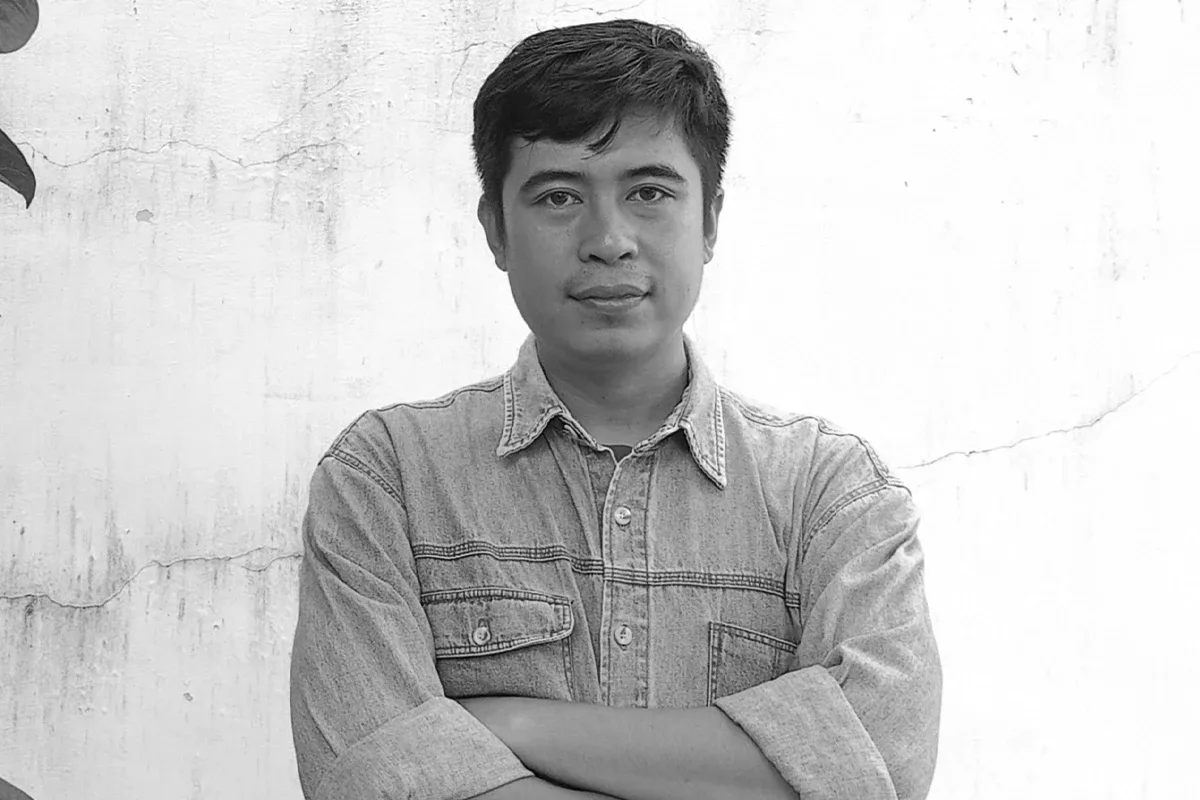
20 May 2026

Get your 2027 tickets!

Get your Early Bird tickets for the big festival nights, Friday & Saturday Night Unlimited!