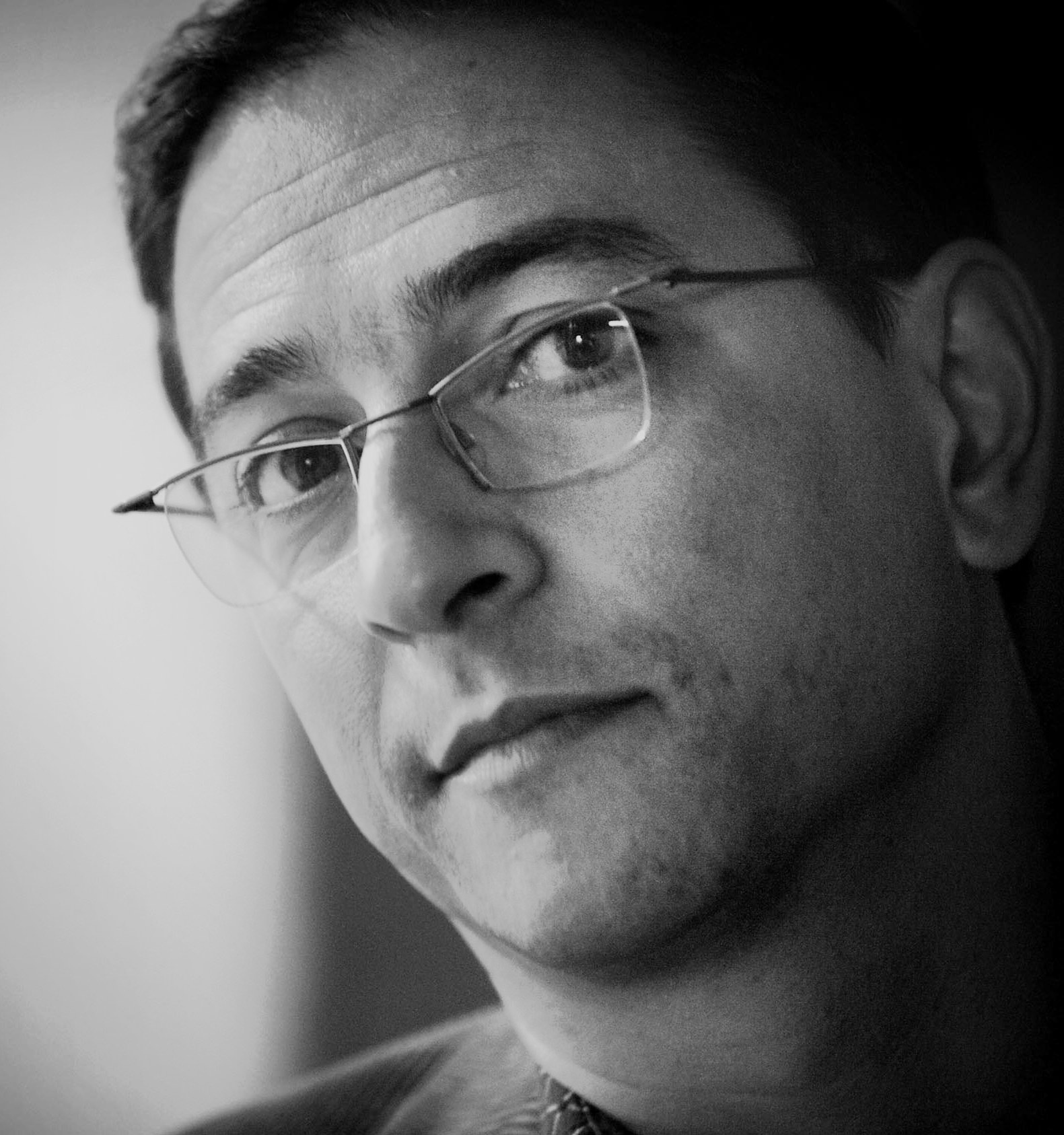
Youssouf Amine Elalamy
(1961, Morocco) acquired fame with his novel Les Clandestins (The Clandestines; (2000), which was translated into Dutch. In this story he gives a face to the Moroccans who in a last desperate effort try to reach Europe and lose their lives. Elalamy belongs to the new crop of young writers who grew up after Moroccan independence from France. The Moroccan identity forms an important leitmotiv in his work. His collection of short stories Tqarqib Ennab (Rumours) from 2004 is the first book fully written in darija, the Moroccan dialect of Arabic. ‘To show it is a real language, alive and creative,’ he said about it in an interview with Trouw. Elalamy has three novels to his name, of which Les Clandestins was awarded the Grand Prix Atlas 2001. In 2004 he published a series of portraits of Moroccans in Morocco (Miniatures). Apart from being a writer Elalamy is a visual artist and a teacher of style and media at the university of Kenitra. In 2009 he made the literary installation Nomad. In Morocco sharp analyses of his literary collages have led to censorship of his visual art. His novels have been translated into Dutch, Arabic, English, Spanish and Italian.
Past events
The Promised Land
For emigrants the shocking contrast between dream and reality is apparently not only a painful but also a rich source of inspiration. Hassnae Bouazza talks to Jean Kwok, originally of China, and Youssouf Amine Elalamy (Morocco) on the everlasting enchantment of the Promised Land. In English.
Wintercafé 3: Metamorphoses
Gündüz Vassaf (Turkey), Nury Vittachi (Hongkong) and the Moroccan author Youssouf Amine Elalamy tell stories about metamorphoses. In English.