Winternacht 2

20050301173351

Information

Date and time Saturday 30 January 1999 from 20:30 to 01:30 hrs
Location Theater aan het Spui & Filmhuis Den Haag

Tijdschema 30 January

Filter by location:
Filter by spoken language:
Time Location
20:30 - 00:01 Filmhuis - diverse locaties Pim de la Parra, retired Surinamese cinematographer
20:30 - 01:30 Theater aan het Spui - diverse locaties Music
20:30 - 23:45 Theater aan het Spui - foyer Performing Poets and stories
20:30 - 23:45 Theater aan het Spui - kleine zaal Surinamese and Papiamentu anthologies
20:30 - 22:30 Theater aan het Spui - grote zaal East-Indian Anthologists
22:45 - 23:45 Theater aan het Spui - grote zaal A Search for East-Indian South-Africa

Aad Nuis

(Sliedrecht, 1933) grew up in Rotterdam, he studied political and social science in Amsterdam, and wrote poetry in the meantime. His studies resulted in a long term membership of Dutch parliament, and finally in the function of Secretary of State for culture and media. His collection of essays on literature and literary criticism Een stem in je hoofd (A voice in your head) was published in 1989. De balenkraai (Crow of bales, 1967) is about the period in New Guinea where he was sent during his military duty (1962). In these personal chronicles, Nuis observes and describes the world around him with mild irony. He met Breyten Breytenbach during an anti-apartheids manifestation and would later translated his Alles één paard (All one horse, 1989).
WN 1998
20050302202110

Agus Sarjono

(Java, 1962) writes poetry, short novels and essays. He studied Indonesian Language and Literature at Bandung and finished his postgraduate program in 2002. Sarjono works as a lecturer at the Faculty of Theatre at Bandung’s Art College. He is editor of the literary journal Horison and the Program Director of The Jakarta Arts Council for the periode of 2002-2006. His work has been published in several media, including the literary journals Horison and Dewan Sastera, as well as the newspapers Jawa Pos and Kompas. His poems have also been included in several anthologies. His work consists out of the collections of poems Kenduri airmata (1994) and A Story from the Country of the Wind (English edition 2001), his essays Bahasa dan Bonafiditas Hantu and Sastra dalam Empat Orba (both 2001)and his drama Atas Nama Cinta (2004).Sarjono has performed at Winternachten 1999, and at literary manifestations in Indonesia, Malaysia and Germany.
WN 2005

20050224120002

Alfred Birney

(Netherlands, 1951) descends from a former plantation-owning family in the Dutch East Indies. His father is Indonesian-Chinese and his mother is Dutch. Recurring themes in his work include alienation from family and the inability to identify with one's mother- or fatherland. His 1987 debut novel was Tamara's Lunapark. He compiled an anthology of Dutch colonial and post-colonial literature, East-Indian Ink, in 1998. In 2002 Indische Gezichten was published, a compilation of his Dutch post-colonial novels Vogels rond een vrouw (Birds around a Woman, 1991) and De onschuld van een vis (The Innocence of a Fish, 1995). These books create an unforgettable portrait of his father. His successful autobiographical novel De tolk van Java (The Interpreter from Java, 2016) received multiple awards and was adapted for theatre. In 2019, the diary Niemand bleef (Nobody stayed) was published in the Privé Domein series, for which he was awarded the Littéraire Witte Prijs 2020. In March 2024, Zwerfpost (Wandering Post) was released, a personal selection from 25 years of articles, blog posts, columns, essays, critiques, lectures, studies, sketches, polemics, travelogues, and portraits of unknown writers with divergent perspectives on the Netherlands versus Indonesia.
20191105134212 1

Antoine de Kom

(Netherlands, 1956) is a psychiatrist, writer and poet. He is a grandson of the Surinamese anti-colonialist, nationalist and resistance fighter Anton de Kom. He has published the poetry volumes Tropen (Tropics, 1991), De kilte in Brasilia (The Chill in Brasilia, 1995), Zebrahoeven (Zebra Hooves, 2001), Chocoladetranen (Chocolate Tears, 2014) and De lieve geur van zijn of haar (The Sweet Smell of Him or Her, 2008). For years De Kom worked as a psychiatrist at the Pieter Baan Centrum. In 2012 he published Het misdadige brein (The Criminal Brain), in which he employs fictitious conversations with historical criminals to show how reports of suspects are drawn up. He won the VSB Poetry Award for  Ritmisch zonder string (Rhythmically without String, 2013).
20191112030504 1

Arahmaiani

(1961, Indonesia) lives and works in Jakarta and Bandung as a painter, poet and sculptor. Her work has been exhibited all over the world. She first appeared in The Hague as a performer during the Winternachten festival of 1997.
WN 1998
20050302204456

Aya Zikken

Epe (1919). She lived on Sumatra and Java during her youth. She gained fame and success in 1955, with her novel De atlasvlinder (The Atlas Butterfly). She uses her numerous travel experiences for her fictional work, but she’s not a travel writer. She was awarded the Anna Bijns Prize for prose in 1997.
WN 1998
20050302205105

Breyten Breytenbach

(1939, Bonnievale) is a South-African writer and painter with French citizenship. He studied at the University of Cape Town. He became a committed opponent of apartheid and left South Africa for Paris in the early 1960s. On returning to South Africa in 1975 he was arrested and sentenced to nine years of imprisonment. In his work The True Confessions of an Albino Terrorist he describes aspects of his imprisonment. After his release in 1982 he returned to Paris. Breytenbach wrote poetry, novels, essays and plays. His poems are rich in metaphores and are a complex mixture of references to Buddhism, Afrikaans idiomatic speech, and memories of the South African landscape. Breytenbach is also known as a painter. Many of his paintings portray surreal human and animal figures, often shown in captivity. He has been honored with numerous literary and art awards. Breytenbach is active in different organizations for South-African political exiles.
20051116094751

Carl Friedman

(Eindhoven, The Netherlands, 1952). Tralievader (± Prison Father, 1991) was her first novella. Jewish history and culture play an important role in her work. Twee koffers vol (Left Luggage) has been made into a film by Jeroen Krabbé. De grauwe minnaar (The Grey Lover) was nominated for the European Prize of Literature in 1997.
(WN 1998)
20050302204001

Clarisse van Haersma Buma

20050302203600

Clark Accord

(Paramaribo, 1961) moved to The Netherlands when he was 17. He studied at medical school and worked for several years at the AMC Hospital in Amsterdam . After that, he studied to be a beautician in Amsterdam and left to live in Vienna for six years. He built a successful career as a make-up artist in several countries and his creations can be seen in magazines such as Elle, Marie-Claire and Elegance. In 1999 he made his debut with the historical novel De koningin van Paramaribo (The queen of Paramaribo) and participated for the first time in the Winternachten festival. In 2001 a musical was made of this succesful book.Clark Accord writes columns for amongst others Man and News Magazine. His second novel Tussen Apoera & Oreala (Between Apoera & Oreala) was published in January 2005.
WN 2005
20050224151949

Dan Jacobson

(Johannesburg, 1929) grew up in South-Africa, but he lives in the United Kingdom since 1954. He write novels, short stories, essays and poetry. He is an emeritus professor of English Literature. In his novel Heshels Rijk (Heshel’s Empire) he searches for his grandfather, a rabbi in a Latvian village, whose death cleared the way for the family’s move to South-Africa, through which they escaped from the holocaust.
20050302204045

Denis Henriquez

(Aruba, 1945). Henriquez studied in Delft, The Netherlands, and now works as a physics teacher in Rotterdam. He wrote several plays and a film scenario. His debut was the novel Zuidstraat (South Street, 1992). In 1995, Delft blues saw the light of day, an often comical sketch of student life in the 1960s.
(WN 1998)
20050302195956

Dirk Vlasblom

(Rotterdam, 1952) studied anthropology, planning and management at Utrecht University. Since then he works mainly as a journalist and writer. In 1990 he became NRC Handelsblad’s foreign correspondent in Jakarta. In 1997 he was awarded the Prize for Daily Paper Journalism for his articles on the Papua’s in Irian Jaya. In 2004 his book Papoea, een geschiedenis (Papua, a history) was published, the first integral historical look at West New Guinea. Other books that Vlasblom has had published about Indonesia are Jakarta, Jakarta – Reportages uit Indonesië (1993) (Jakarta, Jakarta - reports form Indonesia) and In een warung aan de Zuidzee – Verhalen uit Indonesië (In a snackstall by the South Sea, stories from Indonesia) (1998). In these books he describes his experiences of everyday life there, and especially the last book gives a glimpse behind the scenes of being a foreign correspondent. In 2005 he returned to The Netherlands, and now works as a journalist for NRC Handelsblad.
20050302123804

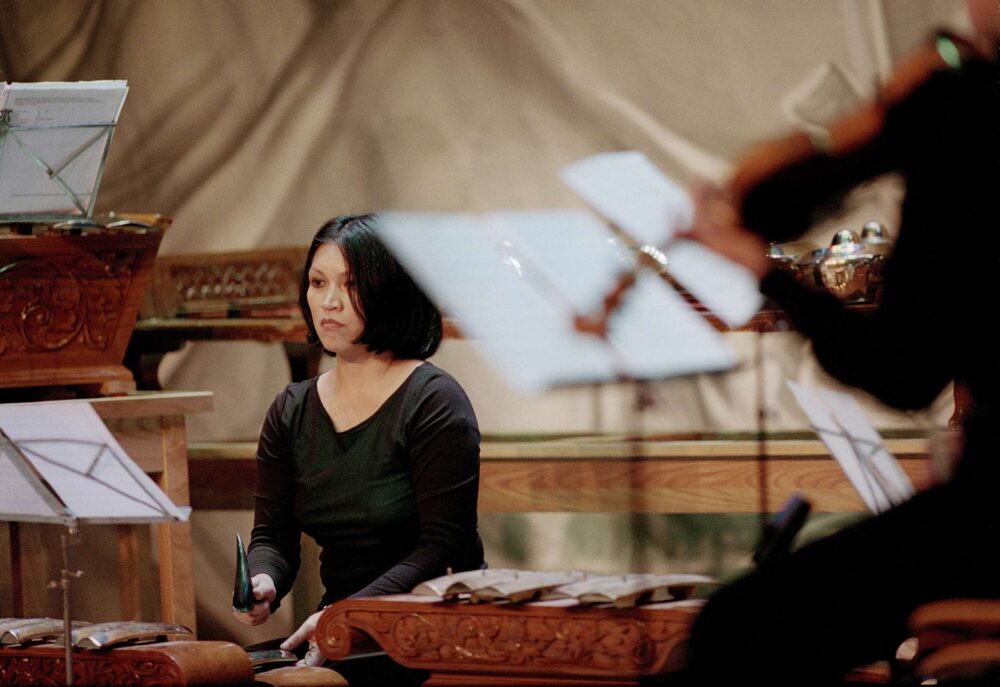
Ensemble Multifoon

performs new compositions written for the chromatic gamelan, combined with western instruments. The set of instruments was purchased through the initiative of ensemble leader Sinta Wullur. The Ensemble Multifoon consists of professional musicians with gamelan experience, and musicians/leaders from Dutch gamelan groups Widosari and Tirta. They performed on several stages in The Netherlands and abroad, in concerts with traditional Javan/Balinese gamelan and concerts with contemporary gamelan music.
WN 2001
20050302142502

Erik Calmes Kwartet

Fra Fra Big Band

Frank Martinus Arion

(Curaçao, 1936) studied Dutch Language and Literature at Leyden University. He lectured at Amsterdam University and from 1975 to 1981 taught at a teacher training college in Surinam. After that he returned to Curaçao to be appointed head of the Instituto Lingkwistiko Antiano. He founded a Papiamento secondary school based on humanistic principles: the Kolegio Erasmo. He writes stories, essays, poetry and novels. His successful debut novel Dubbelspel (Double Play, 1973) is presently being adapted for the screen. Following Dubbelspel the novels Nobele wilden (Noble savages, 1979) and De laatste vrijheid (The last freedom 1995) appeared, which won him the Cola Debrot Prize in 2001. In November 2001 the collection of stories De eeuwige hond (The eternal dog) appeared. His latest novel De deserteurs (The deserters) was published in 2006.
20060123143953

Gerrit Komrij

(Winterswijk, 1944) was the first Poet Laureate of the Netherlands. He is considered one of the best columnists in the country, a novelist, renowned translator, and an enhtusiastic reviewer of poetry. Komrij is a cat in a Strange Warehouse, as he called a book of collected essays that came out in 2001. The world is never a trusted or obvious place, but if you look good, there's always something surprising around. 'I don't think I'm a no-nonsense guy. There's too much noise inside of me'. Komrij, who has lived in Portugal since 1984, is one of the most productive Dutch writers. Since 1968 he has published several works annually. Recently Komrij's choice of the one-hundred best Dutch poems (2008) appeared, in addition to an anthology of Dutch children's poetry in over 1000 poems (2007) and Kakafonie (2006), an 'encyclopaedia of shit'. In 2005 he published Eendagsvliegen (Ephemera, literary diary entries) and a volume of poetry Fata Morgana.
20050226145252

Gert Vlok Nel

(Calvinia, Zuid-Afrika, 1963) is one of the most talented poet and performer in South Africa. In Om te lewe is onnatuurlijk. Eenvoudige spoorwegstories (To live is unnatural. Simple Railway Stories, 1993) he describes his youth in the countryside in Karoo and Beaufort-Wes.
(WN 1998)
20050302204213

Gibi Bacilio

(Curaçao, 1950) is a poet and a literary performer. He studied philosophy and theology in Colombia and The Netherlands. In Utrecht he finished his studies at the Academy of Expression, and became a tutor of dramatic expression. He lives on Curaçao, where he is very active in street theatre, especially with the group Grupo di Teatro Foro of which he was the artistic leader during the seventies and eighties. He produced and presented cultural television programs and trained and became an expert in the field of oral literature and written rhythmic poetry. Bacilio writes about the colonial past, the Indians, the slaves and the dominant and confusing position of the Dutch. But there is also tenderness and eroticism in his work. His poems have been published in various collections and magazines. In 2000 his collection of poems Kueru Marká was published.
20060810113723

Henk Maier

(1950) occupies the chair in Malaysian and Indonesian Language and Literature at Leiden University. He translated work of Pramoedya Ananta Toer: Jejak langkah (Footsteps, 1986) and Rumah kaca (The Glass House, 1988) and other Indonesian authors. He often writes about modern Indonesian literature.
20050302204604

Henk van Woerden

(1947-2005) was a painter and writer. He lived in South Africa since he was nine and after his studies in the arts remigrated to Europe. In 2001 Henk van Woerden made an international breakthrough. In that year he received for his book Een mond vol glas (A mouthful of glass) (1998) the prestigious Sunday Times Fiction/ Alan Paton Award, the award for the best book in South Africa. Een mond vol glas, a chronicle about Tsafendas, the murderder of prime minister Verwoerd, is the last section of a triptych about South Africa. His prose debut Moenie kyk nie (Don't look) (1993), which was crowned with the Geertjan Lubberhuizen award, was the first section. The second section was the novel Tikoes (1996). By the end of 2002 Notities van een luchtfietser (Notes from an air cyclist) appeared, in which van Woerden writes about both his imaginary and his real travels. In February 2003 Henk van Woerden received the Frank Kellendonk award. In October 2005 his last novel was published, Ultramarijn. It was awarded the Flemish literary prize the Gouden Uil in 2006.
20050226183336

Jill Stolk

(Hilversum, 1952) published several books from her Indonesian background: Scherven van smaragd (Fragments of Emerald), Onder de blauwe Sarong (Under the blue sarong) and Kleurverschil (Different Colors). Stories of the older generation were collected in her book Indië was alles. Alles (Indonesia was everything. Everything). Ze died in 2019.
(WN 1998)
20050302205036

Jit Narain

(Jidt Narainsingh Baldewsingh, Livorno, Surinam, 1948) Born in Suriname, Jit Narain is the grandson of Indian immigrants. In 1969 he went to the Netherlands to study medicine and became a doctor in The Hague. He returned to Suriname in 1991. Since then he has been heading the head of an outpatients clinic in Saramacca. He is a fervent defender of the emancipation of Sarnami, the Hindu-Surinamese language and for his efforts received the Rahman Khan prize. Narain writes poems which can be read and sung. The poems reflect the history and memories of Hindustan immigrants in Suriname. He writes in Sarnami and in Dutch, approaching the same secret history of immigrants from different perspectives. He made his debut in 1977 with the poetry collection in Sarnami Dal Bhat Chatni (Rice, yellow peas and chutney). His debut has been followed by six other collections of poetry.
20050302172427

Kester Freriks

(Jakarta, 1954) debuted in Hollands Maandblad with several stories that ended up in the collection Grand Hotel Lembang (1979). He is working on a biography of Maria Dermoût at the moment. Since 1981 he writes reviews about drama and literature for NRC Handelsblad. In 1998 his collection of stories Eeuwig Indië (Eternal Indies) appeared.
20050302203648

Loit Sôls

(Retreat, South-Africa, 1957) grew up in the cape province. He worked as a graphic designer but is now a famous face in Cape Town, being a street singer and poet. He plays guitar and sings in Goema – a composite street language taken from many languages. For Sôls, language is a way of life: Kyk mooi na dié Taal. (Take a good look at this Language). Hoe haal sy asem? (How does it breath?) Noemmit Patois of Pidgin, (Call it Patois or Pidgin), djy waste jou wasem (You are wasting your breath) en djy hoonie rai beat-tie. (And you don’t hear the beat). Taken from: Dié Taal (This Language). In 1998, the collection My streat and other talk-poems appeared.
20050302204133

Michaël Zeeman

(Marken, 1958-2009) was a poet, a writer and a commentator, with a regular column on the Forum page and the book pages of the Volkskrant. Zeeman was the editor of the arts section of the Volkskrant and from 2006-2007 its Rome correspondent. In 2006 he and the writer Abdelkader Benali published an exchange of letters, exchanging ideas on politics, life, love and literature. In 2002 Zeeman received the Gouden Ganzenveer (Golden Goose Quill) for his merits for Dutch literature. Zeeman became well-known in the 1990s as the host of his monthly book programme 'Late at night after a short walk', later to be renamed 'Zeeman with books'. In 1991 he published his first volume of poetry, Beeldenstorm (Iconoclasm), winning him the C. Buddingh Prize. His second volume Verhoudingen (Relationships) appeared in 1995. In the same year he published short stories entitled De Verduistering (The Darkening). He died in 2009.
20080206143715

Michiel van Kempen

(Oirschot, 1957) from 1983 to 1987 he worked in Surinam. Van Kempen is the compiler of two extensive anthologies: Spiegel van de Surinaamse poëzie (Mirror of the Surinamese Poetry) (1995) and Mama Sranan. 200 jaar Surinaamse verhaalkunst (Mama Sranan, 200 Years of Surinamese Storytelling) (1999). In 1997 his first novel, Plantage Lankmoedigheid (Plantation Patience) appeared. He also published: Het Nirwana is een lege trein (Nirvana is an Empty Train) (2000) and Pakistaanse nacht (Pakistani Night) (2002). In 2002 he obtained his doctorate with his thesis Een geschiedenis van de Surinaamse literatuur (A history of Surinamese literature). His anthology Noordoostpassanten (Northeast Transients), which he compiled together with Wim Rutgers, was presented at the Winternachten festival in 2005. In 2006 he published the novel Escape Routes.
20050301220406

Nenden Lilis

(Malangbong-Garut, West-Java, 1971). Author of novellas, essays, reviews – which appeared in many Indonesian media and several collections. She supports the reformasi with her poetry and by taking part in political demonstrations.
20050302204529

Pim de la Parra

(Paramaribo, 1940) made a great number of movies with Wim Verstappen, among which the blockbuster Blue Movie (1971). Their 13th and last movie was WAN PIPEL [‘one people’, spelled phonetically in Dutch]. After his production company went broke, he retreated to Aruba. After his return in 1985, he initiated the 'minimal movie' movement. Returned ‘for good’ to Surinam in 1996.
20050302205650

Rendra

(Solo, Mid-Java, 1935 - Bogor 2009) was a poet, dramatist and actor. From 1964 to 1967 he lived in the United States, where he studied at the American Academy of Dramatic Art. In 1968 he founded the Bengkel Teater in Depok, which was controversial due to its singular choice of material. His unconventional behavior and critical attitude was the cause of conflict with the government. As a poet he debuted in 1957 with the collection Ballada orang-orang tercinta (Ballad of the loved people). Several other collections include Blues untuk Bonnie (Blues for Bonnie, 1961) and Sajak-sajak sepatu tua (Poems of old shoes, 1972) His work has been translated in English, German and Dutch. Rendra placed his poetry in the tradition of Indonesian oral culture and considered literature a 'performing act'.
20151219095835 1

Robert Dorsman

(Utrecht, 1955) is a translator of South African literature. He translated the works of Etienne van Heerden, Breyten Breytenbach and Antjie Krog. With Adriaan van Dis he compiled O wye en droewe land (Oh, wide and sad country), a collection of 101 poems in Afrikaans.
20140828093213 1

Rudy Kousbroek

(Pematang Siantar, 1929 - Leiden, 2010) came to the Netherlands in 1946. In 1951 he published his first collection of poems Tien variaties op het bestiale (Ten variations on bestiality). He has a varied oevre to his name, consisting of many essay collections concerned with diverse subjects. One of which was Het Oostindisch kampsyndroom. Terug naar Negri Pan Erkoms (1995) (The East-Indies Camp syndrome. Back to country of origin), about our colonial past. It offers a refreshing insight on the how and the why of Kousbroek's unique vision of the colonial past. As part of a 400 years Netherlands-Japan relationship Kousbroek, together with film-maker Hans Keller, made the royal journey again. This resulted in an unparalleled journey through time, full of revelations and discoveries. The book In de tijdmachine door Japan (In the time machine through Japan) (2000) forms the background of the film that Hans Keller made for the VPRO. Kousbroek died in 2010.
20050301172504

Soli Philander

(Cape town, 1958) is a popular stand-up comedian in South Africa. He performs as a presenter in television and radio shows and in the theatre. Had a lot of success during his Winternachten 1998 performance. He gives a sharp and humorous comment on the situation in his country.
20050226112716

Soni Farid Maulana

(Tasikmalaya, West-Java, 1962) is a poet and journalist. His poems were published in a large number of Indonesian media. Performed in the Cultural Center TIM in Jakarta and in Bengkel Teater Rendra in Depok.
20050302204639

Trevor Steele Taylor

Trio Klaus Kuiper

Winston Scholsberg

20050301173351

Aart G. Broek

(Maasland, 1954) lived on Curaçao from 1981-2001, exploring the culture of the Antilles and the often discordant relationship of the western world with the non-western world and the causes of violence. He published various books and articles on Antillian writers, Met liefde behandelen (Treat with Love) among others, a tribute to writer Boeli van Leeuwen. In January De hemel is van korte duur (Heaven is Short-Lived) appears, the collected works of Tip Marugg, in which he cooperated with G.W. Rutgers. In 2007 he published De terreur van schaamte, brandstof voor agressie, (The Terror of Shame, Fuel for Aggression) in which he makes critical marginal notes on the realisation of the cultus of violence and the lack of a human approach to aggression and violence. Broek is an independent advisor and researcher working parttime for the Koninklijk Instituut voor Taal-, Land- en Volkenkunde in Leyden on a research project on the history of the police in Suriname and the Dutch Antilles and Aruba.
20081202105734

Jeroen Vullings

(Haarlem, 1962) studied Dutch language and literature at Amsterdam University. He has worked for the magazine Vrij Nederland since 1993 as an edtor and literary critic. Published numerous essays on literature and is at present preparing a biography of the Dutch journalist H.J.A. Hofland. 
20160826144045 1

Lebombo Basa

South African guitarist Phola Mamba is the driving force behind a series of initiatives to play South African jazz with colleagues in The Netherlands. In his band Lebombo Basa he joins forces with guitarist Wiebe Wilbers, bass player Johnny Tevreden and percussionist Serigna Guye.
WN 2001
20050302204830

One Nation

Pim de la Parra, retired Surinamese cinematographer

Information

Date and time Saturday 30 January 1999 20:30 tot 00:01 uur
Location Filmhuis - diverse locaties
20050302205650
Pim de la Parra, from Suriname, was the main guest in the film programme. Clarisse van Haersma Buma, former correspondent in Suriname and the Antilles, spoke to him, as an introduction to three key movies from his oeuvre. 'I feel that I have no more personal ambition to become famous. I want to do something to help things change or make things happen in my country.' Meer details bekijken

Music

Information

Date and time Saturday 30 January 1999 20:30 tot 01:30 uur
Location Theater aan het Spui - diverse locaties
The energetic Surinamese Fra Fra Big Band was one of the performing bands in the theatre venues. With Vincent Henar, Gregory Kranenburg and Carlo Ulrichi. Also there were performances by the young Surinamese-Dutch group One Nation and the Antillian Eric Calmes Quartet. Meer details bekijken

Performing Poets and stories

Information

Date and time Saturday 30 January 1999 20:30 tot 23:45 uur
Location Theater aan het Spui - foyer
20050301173351
The popular South-African performer Soli Philander presented the programme in the foyer, with 'performing poets' and writers from Suriname, Curaçao, South-Africa and Indonesia. The great Indonesian poet Rendra confirmed his excellent qualities as a performer. Winston Scholsberg told traditional Surinamese stories.The Antillian poet Gibi Bacilio performed with percussionist Xavier Cordoba. Jit Narain, Surinamese/Hindustani poet, read his poems in Sarnami. Poet and streetsinger Loit Sôls accompanied himself on guitar. Meer details bekijken

Surinamese and Papiamentu anthologies

Information

Date and time Saturday 30 January 1999 20:30 tot 23:45 uur
Location Theater aan het Spui - kleine zaal
20050302172427
Jeroen Vullings presented a programme with two anthologists. Michiel van Kempen, editor of an anthology of Surinamese literature, talked to Aart Broek, editor of a recently published anthology of Papiamentu literature. Broek introduced three Antillian authors: Gibi Bacilio, a poet and performer form Curaçao, accompanied by percussionist Xavier Cordoba; Frank Martinus Arion (Curaçao) and the Dutch Aruban writer Denis Henriquez. Michiel van Kempen introduced Antoine de Kom and Jit Narain, from Suriname. Meer details bekijken

East-Indian Anthologists

Information

Date and time Saturday 30 January 1999 20:30 tot 22:30 uur
Location Theater aan het Spui - grote zaal
20050302191325
Oost-Indische Inkt is the title of anthology of Dutch East-Indian literature. It was published in 1998. Anthologist Alfred Birney discussed the choices he made, from Multatuli to Marion Bloem. He spoke to Michaël Zeeman and Kester Freriks, writer and critic. Freriks invited two 'Indian' writers: Aya Zikken (whose work was part of the anthology), and Jill Stolk, whose work is not represented in the anthology. Both writers read from their work. Meer details bekijken

A Search for East-Indian South-Africa

Information

Date and time Saturday 30 January 1999 22:45 tot 23:45 uur
Location Theater aan het Spui - grote zaal
20050226111554
Rudy Kousbroek and Henk van Woerden went on a search for East-Indian South-Africa. Descendants of Dutch East-Indian slaves and dissidents, who were deported to the Cape-province, were called 'Malay'. In the 17th and 18th century they raised against the Dutch rulers. Kousbroek and Van Woerden went for a search for what is left of the Malay culture the Cape. Meer details bekijken

Discover
20 May 2026

Get your 2027 tickets!

Get your Early Bird tickets for the big festival nights, Friday & Saturday Night Unlimited!