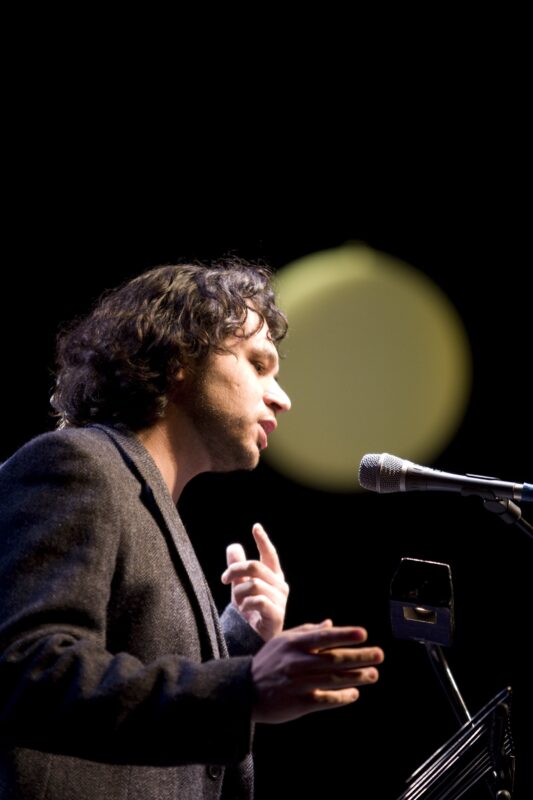
Shabandar Café - Grand Café Oriental

20071123231510

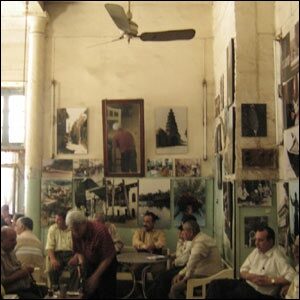
Shabandar Café is a programme by Gemak, the new centre for western and non-western art, politics and debate, of The Hague Gemeentemuseum and the Vrije Academie. With Shabandar Café Gemak links up with the Winternachten festival. Gemak is named after the famous meeting place of artists and intellectuals in Bagdad. Enjoy the most refined forms of Iraqi culture: live classical Arab Moqam music, an Iraqi storyteller and poetr, a short Iraqi documentary on Café Shabandar, tea and the tastiest Iraqi snacks.

The exhisition space of Gemak has been decorated for the occasion in that of the original café, destroyed in March 2007. Honorary guests: the Arab writers taking part in festival Winternachten. An English-Arabic language programme, compiled by the Iraqi visual artist Rashad Selim.
For more information on the programme see www.gemak.org. In English and Arabic

Shabandar is the name of a café on Al Mutanabi Street
where for decades Baghdad’s cultural elites met
discussing books, poetry and politics
or dropping in for a coffee after visiting the book vendors’ stalls
on the busy street outside

Everybody interested in books came here
to buy them in the good years
to sell them during the sanctions
to be transported by their covers
if they were penniless

On the 5th of March 2007
one car bomb attack among many
destroyed Shabandar
and the book market outside

Shabandar Café has left Baghdad
even if its walls are rebuilt
5000 years of urban culture
scattered to the four corners of the Earth

Information

Date and time Sunday 20 January 2008 from 17:00 to 22:00 hrs
Location Gemak

Tamim al-Barghouti

(1977, Egypt) is a poet and political scientist. He is the only son of the Egyptian writer Radwa Ashour and the Palestine poet Mourid Al-Barghouti. Al-Barghouti is working on a publication on political identity in the Middle East and since 2007 has worked at the University of Berlin as a reseach assistant. He has published four books of poetry: Meejana (1999), Al-Manzar (2000), Qaluli Bethebb Masr (2005) and Maqam Iraq (2005). His poems regularly appear in daily papers and magazines in Egypt, Jordan and Palestine. His poems have won Al-Barghouti various prizes, including the poetry prize of the Regional Cultural Foundation in Marrakesh, Morocco. Characteristic for Al-Barghouti’s style is the use of various dialects in his poems, thus he combines Palestinian, Egyptian and Iraqi dialects in combination with Modern Standard Arabic. After his study in politicfal science and international relations he worked some time for the United Nations in New York and Sudan.
20080124150402

Laila Aboezaid

(1950, Morocco) is one of the first Moroccan authors writing in Arabic and whose work is translated in English. Aboezaid actively witnessed the struggle for independence and in her most recent book The Director and Other Stories from Morocco (2006) she writes about the many changes which the struggle for indepenence brought about in Morocco. In her semi-autobiografical novel The Last Chapter. A Moroccan Woman's Life, published in Dutch in 2004, Aboezaid writes about the search for an intellectual Moroccan woman, who, keeping her religious identity, tries to find her personal freedom within Moroccan society. In The Year of the Elephant (1990) independence again plays a major role. In it she writes about the life of a political activist in the period after Moroccan independence in which many Moroccan women were forced back into their traditional roles. Not only in her books does she draw attention to women's rights, in 2002 she was a member of a special commission looking into it. Right now she is writing a biography of the Prophet Mohammed. In addition to novels, Aboezaid has written poetry, articles and short stories.
20080124145840

Ahmed Alaidy

(1974, Saudi Arabia) is an up-and-coming Egyptian writer. In 2003 he published his first novel, An Takoun Abbas El Abd (Being Abbas El Abd), which appeared in English in 2006. The book will be published in a Dutch translation and launched at Winternachten (publishing house De Geus). In his novel Alaidy combines street language with classical Arabic. According to Humphrey Davies, the English translator of the book, this results in “a disorienting sense of a breakdown of borders.” The Egyptian weekly Al-Ahram wrote enthusiastically: “The millennial generation’s most celebrated literary achievement.” In addition to being a novelist Alaidy is a cartoonist. He writes politically orientated cartoons for the Egyptian weekly al-Dostour. He is also a scriptwriter for various tv programmes and films and a graphic designer.
20080122101345

Hatem Bourial

Hassan Daoud

(Lebanon, 1950) after his study of Arabic Literature Daoud worked as a journalist during the civil war in Beirut, among other things as a correspondent for the Arabic newspaper al-Hajaat, published in London. Right now he is executive editor of the cultural pages of the daily paper al-Mustakbal. In addition to literature and culture he occupies himself intensively with daily events in Lebanon and the Middle East. His commentaries on social and political events appear in both Arab and European papers, the Neue Zürcher Zeitung being one of them. In his literary writing Daoud refuses to concern himself with the ‘rhetoric of heroism and tragedy’ of many authors writing about the Lebanese civil war. Instead he aims his attention on the microcosm. Most of his novels are set in Beirut. The House of Mathilde (1983) depicts the life of muslims and christians in an apartment building in Beirut. Daoud, who himself grew up in a home with muslims, christians, Druzes and immigrants from Russia and Armenia, portrays a highly detailed picture of the daily life of the tenants. Between the lines the backgrounds of recent Lebanese social and political history are made visible. Daoud has published two collections of short stories and nine novels.
20080206105627

Youssouf Amine Elalamy

(1961, Morocco) acquired fame with his novel Les Clandestins (The Clandestines; (2000), which was translated into Dutch. In this story he gives a face to the Moroccans who in a last desperate effort try to reach Europe and lose their lives. Elalamy belongs to the new crop of young writers who grew up after Moroccan independence from France. The Moroccan identity forms an important leitmotiv in his work. His collection of short stories Tqarqib Ennab (Rumours) from 2004 is the first book fully written in darija, the Moroccan dialect of Arabic. ‘To show it is a real language, alive and creative,’ he said about it in an interview with Trouw. Elalamy has three novels to his name, of which Les Clandestins was awarded the Grand Prix Atlas 2001. In 2004 he published a series of portraits of Moroccans in Morocco (Miniatures). Apart from being a writer Elalamy is a visual artist and a teacher of style and media at the university of Kenitra. In 2009 he made the literary installation Nomad. In Morocco sharp analyses of his literary collages have led to censorship of his visual art. His novels have been translated into Dutch, Arabic, English, Spanish and Italian.
20080908143303

Ashur Etwebi

(1952, Libiya is a poet, translator and novelist. His first novel Dardanin (2001) was seen by some critics as a turning point in the history of the de Libyan novel, while conservatives cannot appreciate the news style of the book. Since 1993 Etwebi has published five collections of poetry: Poems of the Terrace (1993), Your Friends Passed This Way (2002), River of Music (2004), A Box of the Old Laughs (2005) en Poems from Above the Hill (2006). The fact that he renders his poems in prose form has resulted in a lot of aversion from conservative and 'classical' authors. Etwebi's work is often anthologised in both the Arab world and in Europe. As a translator Etwebi translated poetry by W.B. Yeats and anthologies belonging to American, Lithuanian, French and Canadian modern poetry. Etwebi teaches at the Zawia Teaching Hospital, Zawia University.
20080124145304

Khaled Khalifa

(1966, Syria) is a script writer and a novelist. His latest novel, In Praise of Hatred (2006), which appeared in Lebanon, is banned in Syria. It is about a black page in Syrian history: the unprecedented aggresssive retaliation by the Syrian government against islamists in Homs and Hama, in the 1980s. Reuters and Human Right Watch have taken action in the meantime. Khalifa is working on his fourth novel, A Parallel Life. His first, The Guard of Deception (1993) appeared in 2000 as the The Gypsy Notebooks, banned in Syria for four years. Khalifa works with the Bureau of Educational and Cultural Affairs of the US Department of State. In 2007 he received a medal from the Ismaiiliyah International Festival for Documentaries and in 2005 a prize for the best script at het Valencia Film Festival.
20080206144053

Jonas Hassen Khemiri

(Sweden, 1978) has a Tunesian father and a Swedish mother. He studied literary theory in Stockholm and economics in Paris. In 2003 he made a successful debut with the novel Ett öga rött which was published in a Dutch translation in 2007 (A camel without a hump). In it an Arab pupil struggles with his identity in Stockholm and sets his own cultural background against the social reality around him. The novel was adapted for film. Khemiri's first play, Invasion!, gives an image (of the abuse) of the fear of the other. It was successfully staged in Sweden, Germany and France. Khemiri's second novel, Montecore, is being translated in Dutch.
20080206151522

Lamis Saidi

(Algeria, 1981)) is a young poet, publishing in Arab newspapers and on websites, in addition to taking part in literary festivals. So far she has published one volume, entitled I forgot my bag as usual. She has been attending a French school for two years and lived in Ireland for one year. There she got acquainted with the poetry of Keats, whom she has admired ever since. Saidi studied computer science at the University of Algiers and since 2004 has been working for a French aid organisation.
20080124145614

Habib Selmi

(1951, Tunesia) belongs to the very few Tunesian authors writing in Arabic. A conscious choice, because although fluent in French, he doens't feel at home in French literature. He could never write a French novel, he said in an interview with the literary magazine Banipal. Le-mont-des-chèvres (1999) is a short, poetic, but sometimes grim novella about a conflict between a teacher and the most important dignitary of a small Tunesian village. The teacher symbolises the intellectual and the dignitary power. Les amoureux de Bayya (2003) is his best known work. Selmi's work is characterized by austerity. ‘A novel mustn't be a tale or a myth full of characters and events,’ he said in the same interview in Banipal. Selmi has lived in Paris since 1985, where he is a university lecturer. He has published four novels and two collections of short stories. His books have been translated in English, French, Hebrew and Norwegian.
20080124145002

Discover

20 May 2026

Get your 2027 tickets!

Get your Early Bird tickets for the big festival nights, Friday & Saturday Night Unlimited!